How to Buy Cryptocurrency in Australia (Step-by-Step)
A plain-English, step-by-step guide for Australians: choose an AUSTRAC-registered exchange, verify your ID, deposit AUD, place your first order without overpaying, and secure your crypto in your own wallet.
The short answer
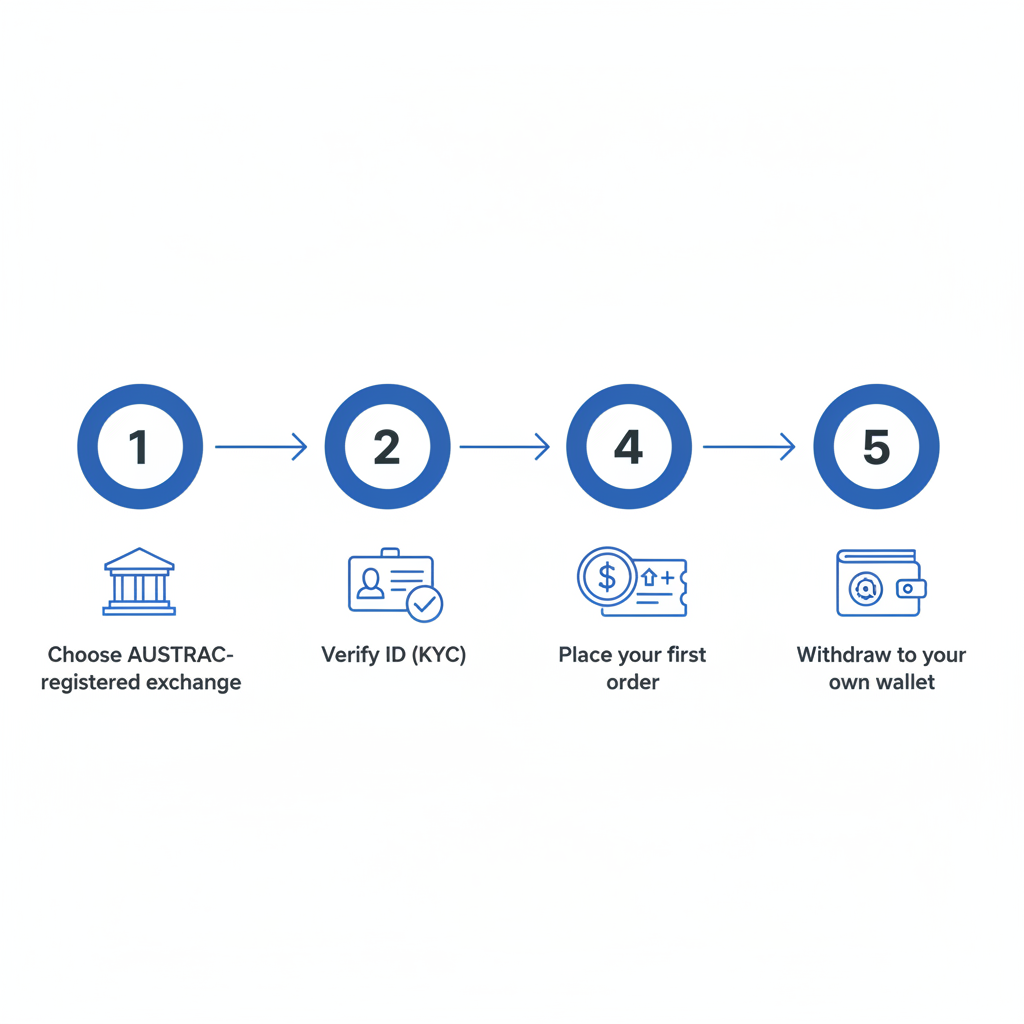
Buying crypto in Australia is genuinely straightforward once you know the steps. The hard part is doing it safely and not overpaying. Here's the whole process in five steps:
- Choose an AUSTRAC-registered Australian exchange. Verify it on AUSTRAC's public register before depositing a cent.
- Create your account and verify your identity (KYC). You'll need ID; it's a legal requirement.
- Deposit Australian dollars. Usually via PayID or bank transfer (often free and fast).
- Place your first order. Use a limit order on the trading screen, not the pricier "instant buy."
- Secure it. Move meaningful holdings off the exchange into your own wallet, and keep records from day one for tax.
That's it. Below, each step in detail, including how to avoid the two most common rookie mistakes: paying hidden costs through wide spreads, and leaving your crypto on the exchange.
Note: This is general educational information, not personal financial advice or a recommendation to buy any cryptocurrency. Crypto is high-risk and you can lose money. For personal financial advice see an ASIC-licensed adviser; for tax, a registered tax agent. Always verify an exchange's current registration yourself.
What you'll need
Before you start, have these ready:
- Photo ID (driver's licence or passport) for identity verification.
- An Australian bank account for depositing AUD.
- An email address and phone for account setup and two-factor authentication.
- A plan for how much to invest. Only money you can afford to lose, decided before you buy.
- (Recommended) A hardware wallet if you're buying a meaningful amount to hold long-term.
The process at a glance
Step 1: Choose a regulated Australian exchange
Your exchange is where you'll buy, so this choice matters most. The non-negotiable first filter is regulation: a legitimate Australian crypto exchange must be registered with AUSTRAC, and you can confirm this yourself on AUSTRAC's public register of digital currency exchange providers. Under Australia's newer Digital Assets Framework, platforms holding customer assets are also increasingly required to hold an AFSL from ASIC, a further positive signal.
Beyond regulation, weigh:
- Total cost. Not just the headline trading fee, but the spread (the gap between buy and sell prices), which is where "low-fee" platforms often make their money.
- AUD support. Fast, reliable deposits and withdrawals (PayID/Osko, bank transfer).
- Security. Strong custody practices and account protections, with a clean track record.
- Ease of getting your records. You'll want to export your full transaction history for tax.
We don't recommend specific exchanges (that depends on your needs), but our full guide on how to choose a crypto exchange in Australia walks through exactly how to compare them. The one rule to remember: an exchange is a place to transact, not a vault. More on that in Step 5.
Step 2: Create your account and verify your identity (KYC)
Once you've chosen a platform, sign up and complete identity verification, known as KYC ("Know Your Customer"). Every regulated Australian exchange must verify your identity by law. It's an anti-money-laundering requirement, not the platform being nosy. You'll typically upload a photo ID and confirm some personal details, and verification is often near-instant.
Set up your security at the same time. Before you deposit a dollar:
- Enable two-factor authentication (2FA). Use an authenticator app (not just SMS) for stronger protection.
- Use a strong, unique password you don't use anywhere else.
- If the platform offers withdrawal address allowlisting and anti-phishing codes, turn them on.
Getting security right at setup is far easier than retrofitting it later, and it protects you from the moment you fund the account.
Step 3: Deposit Australian dollars
With your account verified and secured, fund it with AUD. Most Australian exchanges offer:
| Deposit method | Typical speed | Typical cost |
|---|---|---|
| PayID / Osko | Near-instant | Often free |
| Bank transfer (EFT) | Same day to 1 - 2 days | Often free |
| Debit / credit card | Instant | Usually a fee (avoid if you can) |
PayID is usually the fastest and cheapest. Avoid card deposits where possible. They often carry a percentage fee that eats into your investment before you've even bought anything. Deposit only what you've decided to invest, transferred from your own Australian bank account in your name (using someone else's account can cause compliance problems).
Common mistake: depositing via card for speed and paying a 1 - 3% fee unnecessarily. PayID is usually instant and free.
Step 4: Place your first order
Now you buy. Most exchanges give you two ways to do it, and the difference can quietly cost you real money:
| "Instant Buy" / simple mode | Trading screen (limit order) | |
|---|---|---|
| Ease | Easiest, one tap | Slightly more involved |
| Cost | Often a wider spread / premium | Usually tighter pricing |
| Control | You take the price offered | You set the price you'll pay |
| Best for | Tiny, one-off buys | Almost everyone else |
Market order vs limit order: a market order buys immediately at the best available price (fast, but you don't control the exact price). A limit order lets you set the maximum price you're willing to pay, and it fills only at that price or better. For most people, using the trading screen with a limit order gives better pricing than the convenient "instant buy" button.
Start with an amount you're comfortable with. There's no need to deploy everything at once. Many beginners spread purchases over time using dollar-cost averaging. Once your order fills, congratulations, you own crypto.
Common mistake: using "instant buy" for a large purchase and paying a hidden premium through the spread. For anything beyond a tiny amount, learn the trading screen. It's not as intimidating as it looks.
Step 5: Secure it (don't leave it all on the exchange)
This is the step beginners skip, and it's the most important. Crypto held on an exchange has no government guarantee in Australia. There's no equivalent of the bank deposit guarantee. If the exchange is hacked or fails (as some have, affecting Australians), your funds can be frozen or lost.
The principle: use an exchange to transact, but hold meaningful long-term amounts in your own wallet, where only you control the keys.
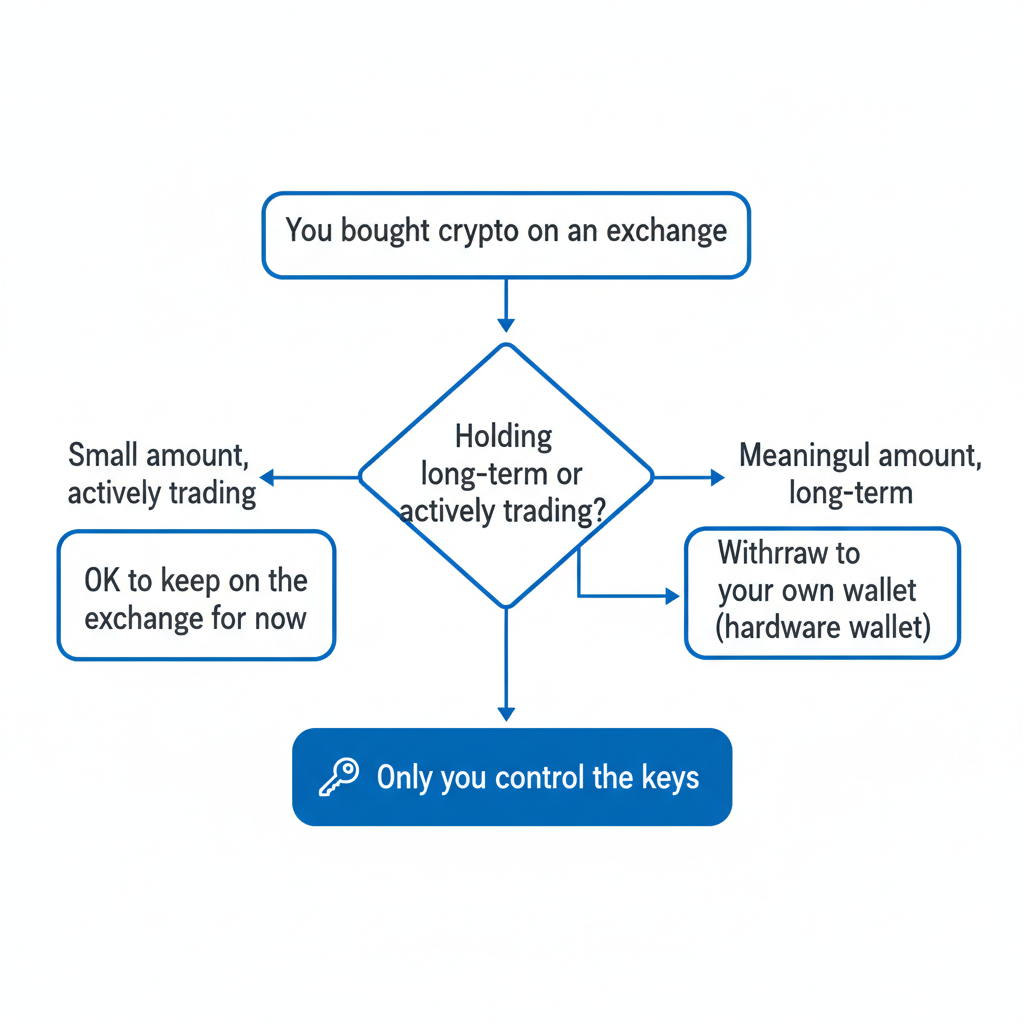
For small amounts you're actively trading, keeping them on a reputable exchange is reasonable. For anything significant you intend to hold, move it to self-custody. Our guides on setting up a wallet and on custody and security walk you through exactly how.
And keep records from day one. Every buy, sell, and swap matters for Australian tax. Disposing of crypto (including swapping one coin for another) is a capital gains tax event. Start a simple record of your transactions now, or connect crypto tax software, so tax time isn't a nightmare.
Common mistakes when buying crypto in Australia
- Skipping the AUSTRAC check. Depositing on an unregulated or offshore platform with no protections.
- Paying card-deposit fees when PayID is instant and free.
- Using "instant buy" for large amounts and losing money to the spread.
- Leaving everything on the exchange instead of self-custodying long-term holdings.
- Investing more than you can afford to lose, or skipping the "how much" decision entirely.
- Not enabling 2FA before funding the account.
- Forgetting records from the first transaction, creating a tax headache later.
- Buying on hype without deciding what and why.
Frequently asked questions
What's the easiest way to buy crypto in Australia?
The simplest route is a reputable, AUSTRAC-registered Australian exchange: create an account, verify your ID, deposit AUD via PayID, and place a buy order. The "instant buy" feature is the easiest single action, but it often costs more through a wider spread, so for anything beyond a small amount it's worth learning the trading screen and using a limit order. Whatever you choose, verify the exchange is AUSTRAC-registered first, and move meaningful holdings into your own wallet afterwards.
How much money do I need to start buying crypto?
Very little. Most Australian exchanges let you start with a small amount (often around $10 - $50), so the barrier to entry is low. The more important question isn't the minimum the platform allows, but how much you should invest, which depends on your circumstances and should only ever be money you can afford to lose. Many beginners start small while they learn the process, then build up gradually. Decide your overall crypto budget before you buy, rather than getting carried away.
Do I have to verify my identity to buy crypto in Australia?
Yes. Every regulated Australian exchange must verify your identity (KYC) by law, as an anti-money-laundering requirement. You'll provide a photo ID and some personal details. This is standard and usually quick. Platforms that don't require identity verification are a red flag, often unregulated or offshore, and using them leaves you without the protections of a compliant Australian exchange. Treat KYC as a sign the platform is operating properly, not an inconvenience.
Is it safe to leave my crypto on the exchange after buying?
For small amounts you're actively trading, keeping them on a reputable, AUSTRAC-registered exchange is reasonable. But crypto on an exchange has no government guarantee in Australia, so if the platform is hacked or fails, your funds can be frozen or lost. For meaningful long-term holdings, the safer approach is to move them into your own wallet, ideally a hardware wallet, where only you control the keys. Use the exchange to transact, not as long-term storage.
What's the cheapest way to buy crypto in Australia?
Deposit AUD via PayID or bank transfer (usually free) rather than card (which often carries a fee), and buy using the exchange's trading screen with a limit order rather than the "instant buy" feature, which typically has a wider spread. Comparing the all-in cost (spreads plus fees) across exchanges matters more than the headline trading rate. Small savings on each purchase add up, especially if you buy regularly.
Do I pay tax when I buy crypto in Australia?
Buying and holding crypto isn't itself a taxable event, but disposing of it later is. Selling for AUD, swapping one crypto for another, or spending it all trigger capital gains tax, even crypto-to-crypto swaps where no dollars change hands. So while the purchase doesn't create a tax bill, you need to keep records from your first transaction, because they'll matter when you eventually sell or swap.
Can I buy crypto with a credit card in Australia?
Often yes, but it's usually the most expensive method. Card purchases frequently carry a percentage fee, and some banks treat crypto card purchases as cash advances with extra charges. Buying with borrowed money (credit) is also risky given crypto's volatility. PayID or bank transfer is almost always cheaper and is the recommended way to fund your account. If you do use a card, understand the fees first.
Just bought your first crypto and not sure if you're set up safely, or how much to buy next? Get an independent, expert second opinion on your crypto, with no token holdings and no conflicts. Book a free portfolio review call.
Next in the how-to hub: now lock everything down with our crypto security checklist, then learn how to send, receive and swap safely.
Next in the how-to hub
Next in the how-to hub: once you've bought, learn how to set up a crypto wallet to store it safely, then lock down your security checklist.
Explore all how-to guides

Mario Stanic · Founder, Crypto Research Australia
Founder of Crypto Research Australia and a self-taught algorithmic trading expert with a proven track record executing multi-billion-dollar trading volume across futures and spot markets. Featured as a crypto expert and market analyst in the Sydney Morning Herald, The Age, the Australian Financial Review, and Channel 9.
Thanks for reading. Take it from the top, or keep exploring our research.