How to Cash Out and Sell Your Crypto in Australia
A step-by-step guide to cashing out crypto in Australia, moving to an AUSTRAC-registered exchange, selling for AUD, withdrawing to your bank, and accounting for capital gains tax (including the 2027 CGT changes).
The short answer
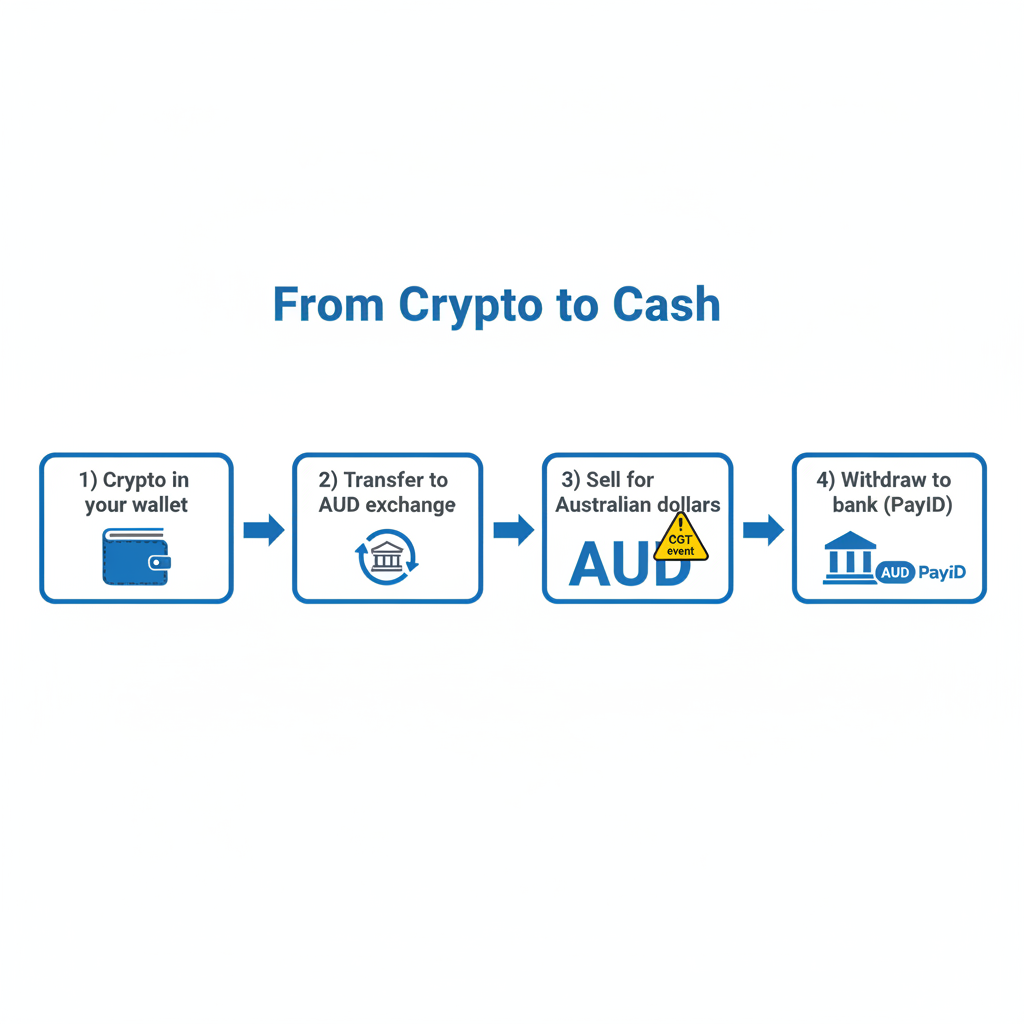
Turning crypto back into Australian dollars in your bank account is a four-step process - and the part most people overlook is the tax. Here's the whole thing:
- Move your crypto to an exchange (if it's in your own wallet) - a regulated, AUSTRAC-registered Australian exchange.
- Sell it for Australian dollars - use a limit order on the trading screen for better pricing than "instant sell."
- Withdraw the AUD to your bank - usually via PayID or bank transfer.
- Account for capital gains tax - selling is a CGT event, so calculate your gain or loss and keep records.
The mechanics are easy. The thing to plan for is that selling (or swapping) crypto is a taxable disposal in Australia, and large bank transfers can attract questions, so good records matter. Below, each step - plus how the 50% CGT discount and the upcoming 2027 changes affect what you keep.
Note: This is general educational information, not personal financial or tax advice. Tax outcomes depend on your circumstances and are changing - confirm yours with a registered tax agent. For personal financial advice, see an ASIC-licensed adviser.
What you'll need
- The crypto you want to sell, in a wallet or exchange account.
- A verified account on an AUSTRAC-registered Australian exchange with AUD withdrawals.
- Your Australian bank account details (in your own name).
- Your transaction records - what you paid, when, and fees - to work out your capital gain or loss.
The process at a glance
Step 1: Move your crypto to an exchange
If your crypto is already on an exchange, skip to Step 2. If it's in your own wallet (as it should be for long-term holdings), you'll first transfer it to an exchange that can convert it to AUD:
- On the exchange, choose "Receive"/"Deposit" for the asset and copy the deposit address (and network).
- From your wallet, send to that address - verify the address and match the network (see our guide on sending, receiving and swapping crypto).
- Send a small test amount first for large holdings, then the rest once it arrives.
Use an AUSTRAC-registered Australian exchange that supports AUD withdrawals - verify it on AUSTRAC's public register. Not every platform makes it easy to get Australian dollars back to your bank, so this matters.
Step 2: Sell your crypto for Australian dollars
Once the crypto is on the exchange:
- Go to the trading screen for the asset against AUD.
- Choose how much to sell - all of it, or part (see "How much should you cash out?" below).
- Use a limit order (set your sell price) rather than the convenient "instant sell," which usually has a wider spread. A market order sells immediately at the best available price if you prioritise speed over precision.
- Confirm the sale. Your account balance converts to AUD.
| "Instant sell" / simple mode | Trading screen (limit order) | |
|---|---|---|
| Ease | Easiest - one tap | Slightly more involved |
| Pricing | Often a wider spread | Usually tighter |
| Control | Take the price offered | Set your price |
| Best for | Tiny amounts | Most sales of any size |
Common mistake: using "instant sell" for a large amount and losing money to the spread. For anything beyond a small sum, the trading screen pays off.
Step 3: Withdraw Australian dollars to your bank
With AUD in your exchange account, withdraw it:
- Choose "Withdraw AUD" and select your method.
- Enter your Australian bank account (in your own name - using another person's account can cause compliance issues).
- Confirm and wait. Timing depends on the method:
| Withdrawal method | Typical speed | Typical cost |
|---|---|---|
| PayID / Osko | Near-instant to same day | Often free |
| Bank transfer (EFT) | Same day to 1–2 business days | Often free |
A note on large transfers: banks and exchanges monitor large or unusual transactions as part of anti-money-laundering rules, so a big withdrawal may prompt verification or questions. This is normal - having clear records of where the funds came from (your exchange, your own trading) makes it straightforward. First-time large withdrawals can also face a short hold or staged limits.
Step 4: Account for capital gains tax
This is the step that catches people out, so plan for it. In Australia, selling crypto is a capital gains tax (CGT) event - and so is swapping one crypto for another, or spending it. When you sell:
- You have a capital gain if you sold for more than your cost base (what you paid plus fees), or a capital loss if for less.
- Individuals who held the asset for more than 12 months generally qualify for the 50% CGT discount, halving the taxable gain.
- Capital losses can offset capital gains and be carried forward to future years.
- Your gain is added to your income and taxed at your marginal rate (after any discount).
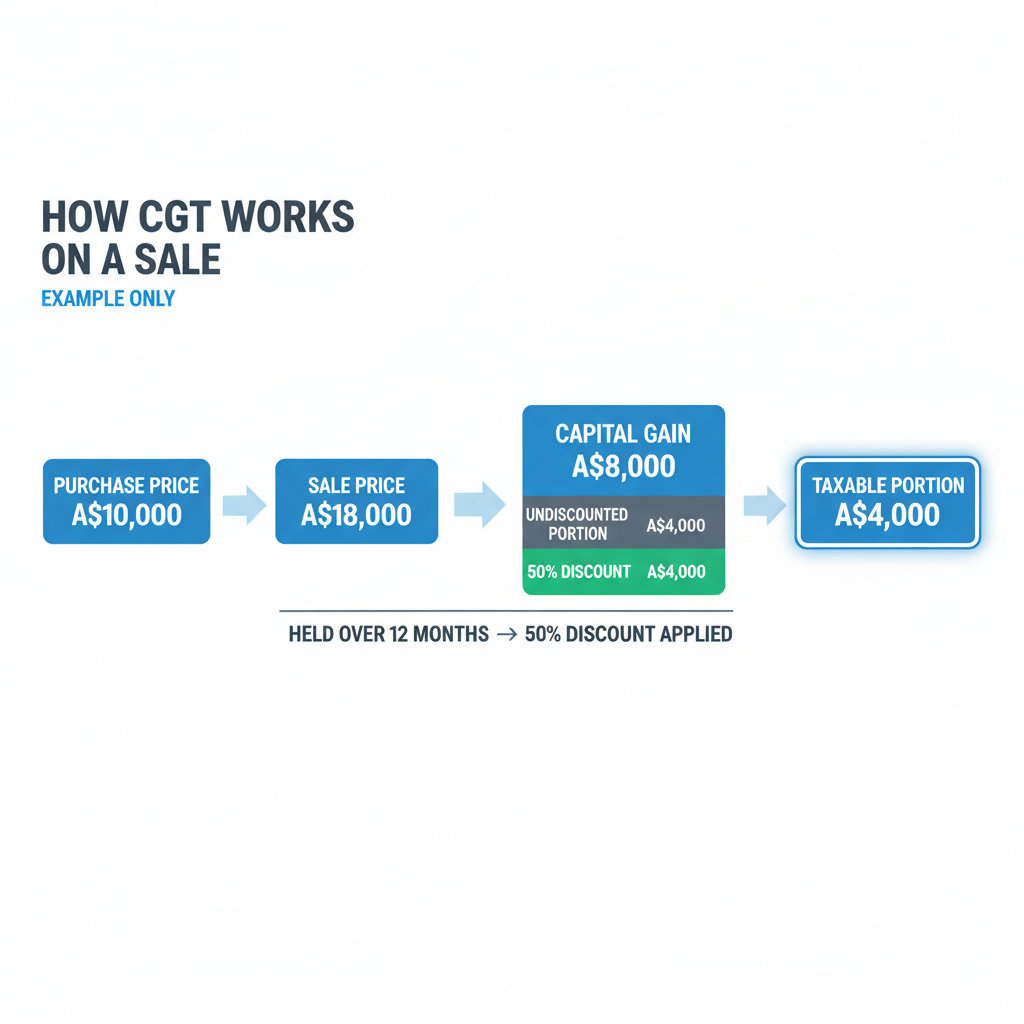
The upcoming change: as announced in the May 2026 Federal Budget, from 1 July 2027 the 50% CGT discount is to be replaced (for individuals) with a system based on inflation indexation plus a 30% minimum tax on net gains - applying broadly to crypto, shares, and property. Gains made before 1 July 2027 keep the current 50% discount. This is subject to final legislation, so confirm the current rules with a registered tax agent when you sell.
Keep records of everything - purchase and sale dates, amounts, AUD values, and fees. The ATO's crypto data-matching program means your records need to hold up. (Our full guide on doing your crypto tax in Australia walks through it, and our guide on taking profit in crypto covers the strategy side.)
How much should you cash out?
You don't have to sell everything at once. Common approaches include taking out your original investment once you're in profit (so you're "playing with house money"), selling a fixed percentage, or selling in stages rather than trying to pick the top. The right approach depends on your goals, your tax position (the 12-month mark can matter), and your plan - not on emotion or panic. Selling in a rush during a price spike or crash is how people make decisions they regret. (Our guides on taking profit and on whether to buy, hold or sell go deeper.)
Common mistake: panic-selling everything during a dip, or dumping at a peak in excitement - both emotional reactions rather than planned decisions. Have a plan before you're in the moment.
Converting to a stablecoin instead of cashing out
Some people, instead of withdrawing to a bank, convert volatile crypto into a stablecoin (a crypto designed to track a currency like the US dollar) to "park" value without exposure to price swings - then convert back later. Understand two things before doing this. First, in Australia, converting crypto to a stablecoin is still a disposal for CGT purposes - a taxable event - even though you haven't reached Australian dollars. Second, stablecoins carry their own risks (they depend on the issuer maintaining the peg and backing), so they aren't risk-free cash. Converting to a stablecoin is a crypto-to-crypto swap, not a true cash-out, and it's taxed like one. If your goal is to realise Australian dollars, you still need to sell and withdraw.
Timing, the financial year, and the 12-month mark
When you sell can affect what you keep. Under current rules, holding an asset for more than 12 months before selling generally qualifies you for the 50% CGT discount - so selling just before that mark, versus just after, can change your tax materially. The financial year in which you sell also matters, because gains and losses are tallied per year. None of this should override your actual investment view - don't hold a falling asset purely for a tax date - but being aware of the timing helps you make a more informed decision. Always confirm specifics with a registered tax agent, especially with the rules changing from 1 July 2027.
Common mistakes when cashing out
- Forgetting the tax - not realising selling is a CGT event, and getting a surprise bill.
- Not keeping records of purchase prices, dates, and fees, making CGT hard to calculate.
- Using "instant sell" for large amounts and losing money to the spread.
- Withdrawing to someone else's bank account, causing compliance problems.
- Being caught off guard by verification on a large transfer (have records ready).
- Selling the 12-month mark without realising holding a little longer could halve the taxable gain (under current rules).
- Panic-selling or euphoria-selling instead of following a plan.
Frequently asked questions
How do I turn my crypto into cash in Australia?
Move your crypto to an AUSTRAC-registered Australian exchange that supports AUD (if it's not already there), sell it for Australian dollars on the trading screen, then withdraw the AUD to your own bank account via PayID or bank transfer. The process is straightforward, but remember that selling is a capital gains tax event, so calculate your gain or loss and keep records. For better pricing, use a limit order rather than the "instant sell" feature, and for large withdrawals, have your records ready in case of verification.
Do I pay tax when I cash out crypto in Australia?
Yes - selling crypto for Australian dollars is a capital gains tax event. You'll have a capital gain or loss based on the difference between your sale price and your cost base (what you paid plus fees). If you held the asset for more than 12 months, you generally qualify for the 50% CGT discount under current rules. Note that, as announced in the May 2026 Budget, the discount is to change from 1 July 2027 (gains before then keep the current discount). Swapping crypto or spending it are also taxable. Confirm your position with a registered tax agent.
How long does it take to withdraw money to my bank?
It depends on the method and the exchange. PayID/Osko withdrawals are often near-instant to same-day, while standard bank transfers can take same-day to one or two business days. First-time withdrawals, or large amounts, may face a short hold or staged limits as a security and anti-money-laundering measure. This is normal. Once you've withdrawn successfully before, subsequent withdrawals are usually quicker. If a withdrawal is taking longer than expected, check the exchange's status and any verification requests.
Why is my large crypto withdrawal being questioned?
Banks and exchanges are required to monitor large or unusual transactions under anti-money-laundering rules, so a sizeable withdrawal may trigger verification or questions about the source of funds. This isn't an accusation - it's routine compliance. Having clear records (showing the funds came from your own exchange account and trading) makes it easy to satisfy. To avoid surprises, keep your transaction history accessible, and be aware that first-time large transfers in particular may face extra checks or staged limits.
Should I sell all my crypto at once or in parts?
That depends on your goals, tax position, and plan rather than a single right answer. Selling in stages (rather than trying to time the exact top) is a common way to reduce the risk of mistiming, and the 12-month holding mark can matter for the CGT discount under current rules. Some people take out their original investment once in profit and let the rest ride. The key is to decide based on a plan, not on panic during a dip or excitement during a spike. Our guides on taking profit and on buy/hold/sell decisions explore this.
Can I avoid tax by cashing out small amounts?
No - each sale is a CGT event regardless of size, and the ATO's data-matching program tracks crypto activity, so there's no way to sidestep tax by selling in small amounts or assuming it won't be noticed. What you can do, legitimately, is manage your tax position - for example, being mindful of the 12-month holding mark for the discount, offsetting gains with losses, or timing disposals across financial years. These are legitimate planning considerations, not avoidance. Always confirm with a registered tax agent, and keep complete records.
What if I'm cashing out at a loss?
A capital loss isn't all bad news for tax: capital losses can be used to offset capital gains in the same year, and unused losses can be carried forward indefinitely to offset future gains. So if you sell at a loss, record it - it has value at tax time. That said, selling at a loss should be a planned decision (for example, if your view on an asset has changed), not a panic reaction to a temporary dip. Our guide on whether to buy, hold or sell can help you think it through rather than react emotionally.
Is converting crypto to a stablecoin a way to avoid tax?
No - in Australia, converting crypto to a stablecoin is treated as a disposal and is a capital gains tax event, just like selling for dollars or swapping for any other crypto. You haven't avoided tax by stopping at a stablecoin; you've simply made a crypto-to-crypto swap, which is taxable. Stablecoins can be useful for reducing price volatility while staying in crypto, but they don't defer or avoid CGT, and they carry their own risks around the issuer and peg. If you want certainty, confirm the treatment with a registered tax agent.
Where can I cash out crypto for Australian dollars?
Through an AUSTRAC-registered Australian exchange that supports AUD deposits and withdrawals - you sell on the exchange and withdraw Australian dollars to your bank. Not every platform makes AUD withdrawals easy, so check this before you need to cash out. A reputable local exchange with bank withdrawals is the standard, straightforward route. Verify any platform on AUSTRAC's public register first, and prefer one with a solid track record, reasonable withdrawal fees, and reliable AUD support.
Thinking about cashing out and want an objective, independent view first - on timing, tax implications, and whether it fits your plan? Get an expert review with no token holdings and no conflicts. Book a free portfolio review call.
Next in the how-to hub
Next in the how-to hub: want to earn on crypto you're holding? Learn how to stake crypto and earn rewards, and the real risks involved.
Explore all how-to guides

Mario Stanic · Founder, Crypto Research Australia
Founder of Crypto Research Australia and a self-taught algorithmic trading expert with a proven track record executing multi-billion-dollar trading volume across futures and spot markets. Featured as a crypto expert and market analyst in the Sydney Morning Herald, The Age, the Australian Financial Review, and Channel 9.
Thanks for reading. Take it from the top, or keep exploring our research.