How to Stake Crypto and Earn Rewards (and the Risks)
A plain-English guide to staking crypto in Australia - what it is, how to stake through an exchange or your own wallet, the real risks (price, lock-ups, slashing, platform risk), and how staking rewards are taxed.
The short answer
Staking lets you earn rewards on certain crypto by helping secure its network - a bit like earning a yield, but with real risks that a savings account doesn't have. The essentials:
- What it is: locking up a "proof-of-stake" crypto to help validate the network, earning rewards in return.
- How to do it: the easy way is through an exchange's staking feature; the more independent way is staking from your own wallet (native or via a validator).
- The risks are real: lock-up periods, potential penalties ("slashing"), platform/custodial risk, and, above all, the asset's price can fall further than any reward you earn.
- Australian tax: staking rewards are generally treated as ordinary income at their AUD value when you receive them, then a separate capital gains event applies when you later sell them.
Staking can be a legitimate way to earn on crypto you're already holding long-term, but it is not a risk-free "interest account," and the rewards can be dwarfed by price moves. Here's how it works, how to do it, and what to watch.
Note: This is general educational information, not personal financial or tax advice, and not a recommendation to stake. Staking carries risk, including loss of value. Some staking products may be regulated financial products in Australia. For tax, see a registered tax agent; for personal advice, an ASIC-licensed adviser.
What you'll need
- A proof-of-stake crypto that supports staking (not all crypto can be staked, Bitcoin, for example, can't).
- Either an exchange account with a staking feature, or a wallet that supports staking.
- An understanding of the lock-up / unbonding period for the asset (your funds may not be instantly accessible).
- A way to record rewards as you receive them, for tax.
What staking actually is
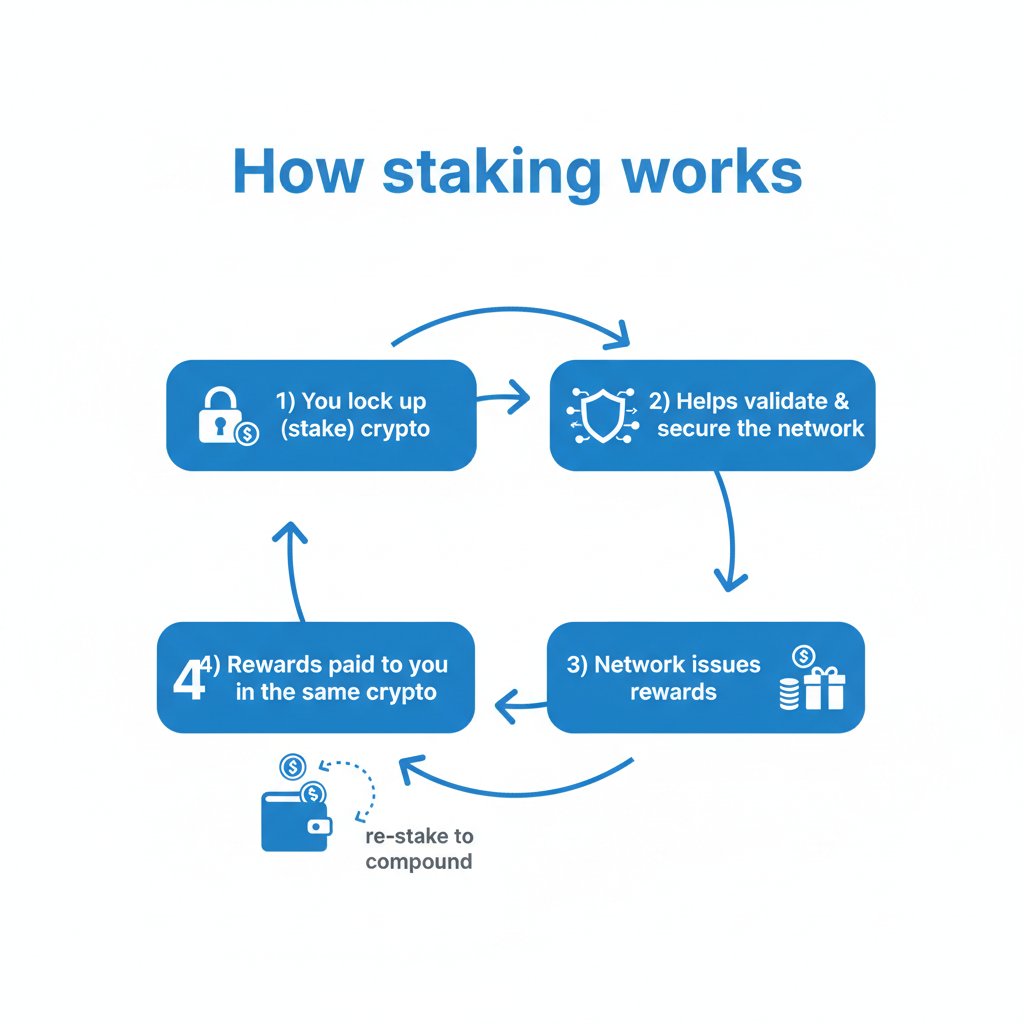
Some blockchains secure themselves using proof-of-stake, where participants lock up ("stake") the network's crypto to help validate transactions, and are rewarded with more of that crypto for doing so. By staking, you're contributing to the network's security and, in return, earning a share of the rewards it issues. It's often compared to earning interest, but the comparison is loose and a little misleading, because the mechanics and the risks are different.
The key point: rewards are paid in the same crypto you staked, and that crypto's price still moves. So your real return depends on both the reward rate and what the asset's price does, a healthy reward rate means little if the asset falls sharply.
How to stake: your options
There are a few ways to stake, trading off ease against control:
| Method | How it works | Ease | Trade-offs |
|---|---|---|---|
| Exchange staking | The exchange stakes on your behalf | Easiest | Custodial, you trust the platform; rewards may be lower |
| Native / wallet staking | You stake from your own wallet to a validator | Moderate | More control; you choose a validator; keep custody |
| Liquid staking | You stake and receive a tradeable token representing your stake | Moderate | Keeps liquidity, but adds smart-contract risk |
| Staking pools | You combine with others to stake | Easy to moderate | Convenient; may involve a third party |
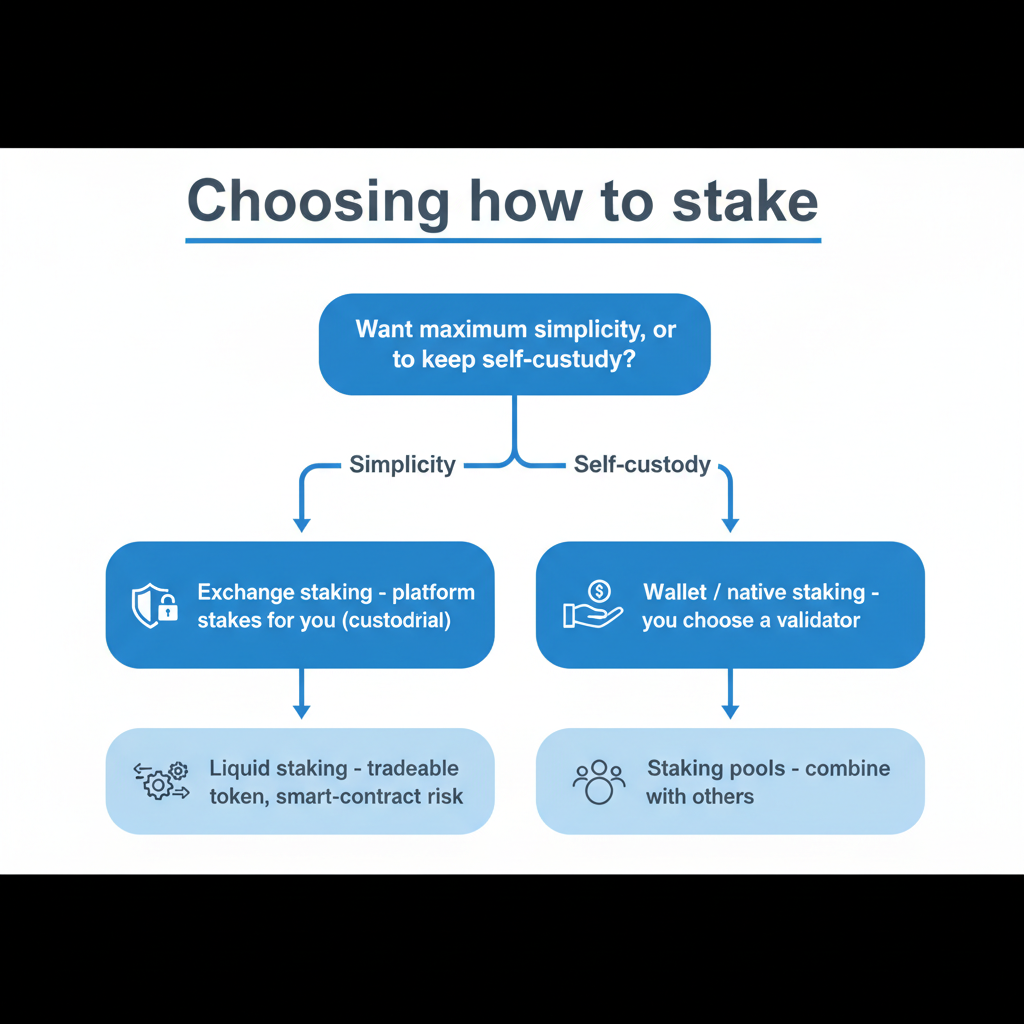
For most beginners, exchange staking is the simplest entry point. Those who prioritise self-custody often prefer staking from their own wallet. Note that pooled or managed staking products may be treated as financial products in Australia (ASIC has indicated this), which affects how they're offered and regulated.
How to stake (step by step)
Option A: Staking through an exchange (easiest)
- Hold a stakeable asset in your account on an exchange that offers staking.
- Find the "Staking" / "Earn" section and select the asset.
- Review the reward rate, lock-up/unbonding period, and terms, including whether rewards compound and how you exit.
- Choose an amount and confirm. Your crypto is now staked, and rewards accrue per the platform's schedule.
- Record your rewards as they're paid (for tax) and monitor the terms.
Option B: Staking from your own wallet
- Hold the asset in a wallet that supports staking (some hardware wallets do, which keeps your keys secure).
- In the wallet, choose "Stake" and, if required, select a validator, favour reputable, reliable validators with a good track record (a validator that misbehaves can cost you via slashing).
- Confirm the stake, noting the unbonding period (the time to unstake before funds are liquid again).
- Rewards accrue to your wallet; you can often re-stake them to compound.
- Keep records of rewards received and their AUD value at the time.
Common mistake: chasing the highest advertised reward rate without reading the lock-up terms or assessing the platform's and validator's reliability. A high rate means nothing if you can't exit when you need to, or if the asset's price collapses.
The risks (this isn't a savings account)
Staking is often marketed as easy passive income, but the risks are real and worth taking seriously:
- Price risk (the big one): rewards are paid in the staked crypto, whose price can fall, potentially far more than you earn in rewards. A 6% reward means little if the asset drops 40%. Your real return is reward plus price change.
- Lock-up / unbonding periods: staked funds are often not instantly accessible. There may be a delay (days or longer) to unstake, during which you can't sell even if prices are crashing.
- Slashing: on some networks, if the validator you stake with misbehaves or goes offline, a portion of the staked funds can be penalised ("slashed"). Choosing a reliable validator matters.
- Platform / custodial risk: with exchange or third-party staking, you're trusting that platform, if it fails or is hacked, your staked funds are at risk (no government guarantee in Australia).
- Smart-contract risk: liquid staking and DeFi staking rely on smart contracts, which can have bugs or be exploited.
- Complexity and tax: rewards create ongoing income tax obligations and record-keeping (below).
The honest summary: staking can be reasonable for crypto you're already committed to holding long-term, but treat advertised yields with scepticism, never assume your capital is safe, and never stake money you can't afford to have locked up or lose.
How staking is taxed in Australia
This is important and often missed. In Australia, staking rewards generally have two tax touchpoints:
- On receipt, ordinary income. When you receive staking rewards, their AUD value at that time is generally treated as ordinary income, and is taxable in the year received (similar to interest, in tax terms).
- On disposal, capital gains tax. When you later sell or swap those reward tokens, that's a separate CGT event, with the cost base being their value when you received them.
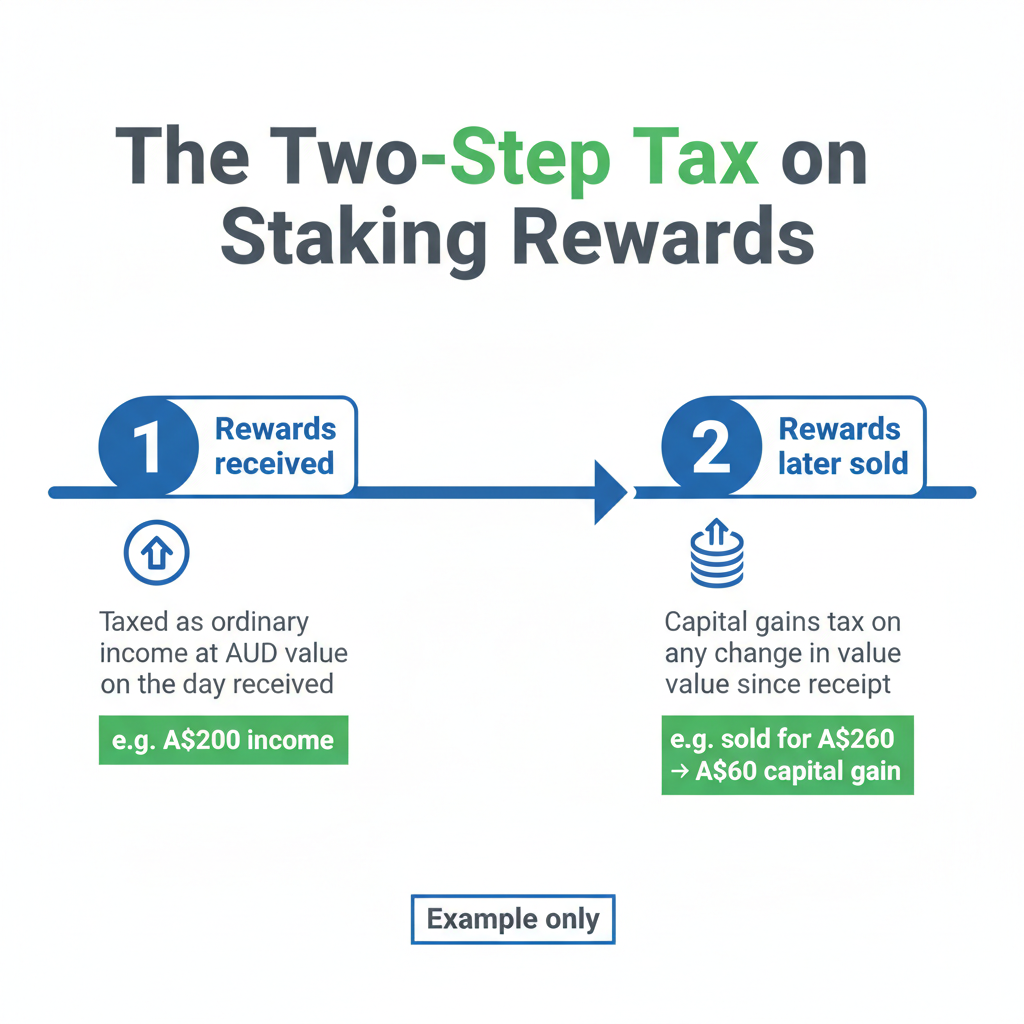
So staking creates ongoing record-keeping: you need the AUD value of rewards each time you receive them, plus the usual records for when you dispose of them. This catches people out, especially with frequent reward payouts. Keep good records (or use crypto tax software), and confirm your situation with a registered tax agent. (Our guides on crypto tax in Australia and doing your crypto tax cover this in depth.)
Is staking worth it? A simple way to decide
Staking can make sense, but only in the right circumstances. A simple filter: it's most reasonable for crypto you already intend to hold long-term and are comfortable leaving locked up, staking that crypto can earn a return on holdings you weren't going to sell anyway. It makes far less sense to buy crypto purely to chase a staking yield, or to stake money you might need access to, because the asset's price risk and lock-up periods can easily outweigh the rewards. Ask yourself: would I hold this asset anyway? Am I comfortable with the lock-up? Do I trust the platform or validator? Have I accounted for the tax? If the answers are yes, staking can be a sensible way to earn on a long-term holding. If you're reaching for the highest advertised yield, that's usually a sign to slow down.
Common mistakes when staking
- Treating staking as a risk-free savings account, it isn't; capital and rewards can both fall.
- Chasing the highest yield without checking lock-up terms, validator reliability, or platform risk.
- Ignoring price risk, a good reward rate can be wiped out by a falling asset price.
- Not understanding lock-up/unbonding, being unable to sell when you want to.
- Overlooking slashing by staking with an unreliable validator.
- Forgetting the income tax on rewards at receipt, then the CGT on disposal.
- Staking money you can't afford to lock up or lose.
- Using an unregulated platform offering implausible returns (a common scam pattern).
Frequently asked questions
What is crypto staking in simple terms?
Staking is locking up a "proof-of-stake" cryptocurrency to help secure its network, earning rewards in the same crypto in return. It's often compared to earning interest, but that comparison understates the risk: rewards are paid in the crypto you staked, whose price can rise or fall, so your real return depends on both the reward rate and price movements. You can stake easily through an exchange, or from your own wallet for more control. It's a way to earn on crypto you're holding long-term, not a risk-free income source.
Is staking crypto safe?
Staking carries real risks, so it's not "safe" in the way a bank account is. The biggest risk is that the staked asset's price can fall further than any reward you earn. Other risks include lock-up periods (you may not be able to sell instantly), slashing penalties if your validator misbehaves, platform or custodial risk if you stake through a third party that fails, and smart-contract risk with liquid staking. Staking can be reasonable for crypto you're committed to holding, but never assume your capital is safe, and never stake money you can't afford to lose or lock up.
How much can I earn from staking?
Reward rates vary widely by asset and method, and any advertised rate should be treated with caution rather than as a guarantee. More importantly, the headline reward rate isn't your real return, because rewards are paid in the staked crypto, your actual outcome depends heavily on the asset's price. A solid reward rate can be completely outweighed by a falling price, or amplified by a rising one. Be especially sceptical of platforms advertising unusually high or "guaranteed" returns, as these are a common scam pattern. Focus on the total picture, not the advertised yield.
Can I stake Bitcoin?
No. Bitcoin uses proof-of-work (mining), not proof-of-stake, so it has no native staking mechanism. Staking applies to proof-of-stake cryptocurrencies. Be wary of any platform claiming to offer "Bitcoin staking" with attractive returns, as this usually means lending your Bitcoin to a third party (which carries significant counterparty risk) or is an outright scam. If earning rewards through staking is your goal, it applies only to proof-of-stake assets, not Bitcoin.
How are staking rewards taxed in Australia?
Generally in two steps. First, when you receive staking rewards, their AUD value at that time is treated as ordinary income and is taxable in the year received. Second, when you later sell or swap those reward tokens, that's a separate capital gains tax event, with the cost base being their value when you received them. This means staking creates ongoing record-keeping, you need the AUD value of rewards each time they're paid. It's a commonly missed obligation, so keep good records or use crypto tax software, and confirm your situation with a registered tax agent.
What's the difference between staking on an exchange and from my own wallet?
Exchange staking is the easiest, the platform stakes on your behalf and you don't manage validators, but it's custodial, meaning you trust the exchange with your funds, and rewards may be lower after the platform's cut. Wallet (native) staking lets you keep self-custody and choose your own validator, offering more control and security over your keys, at the cost of a little more complexity. Beginners often start with exchange staking; those prioritising self-custody prefer wallet staking. Either way, understand the lock-up terms and, for wallet staking, choose a reliable validator.
What is slashing, and should I worry about it?
Slashing is a penalty on some proof-of-stake networks where a portion of staked funds can be lost if the validator you're staking with misbehaves, for example, by going offline or acting maliciously. It's a mechanism to keep validators honest. For stakers, the practical implication is to choose a reputable, reliable validator with a good track record, since their failures can cost you. With exchange staking, the platform manages this, but you take on platform risk instead. Slashing is one more reason staking isn't risk-free, though careful validator choice reduces the risk.
Can my staked crypto be locked up so I can't sell it?
Often, yes. Many assets have a lock-up or "unbonding" period, meaning that when you decide to unstake, there's a delay (which can range from days to longer) before your funds are liquid and sellable. During that window, you can't sell even if the price is falling. This is a genuine risk: you could be locked in through a downturn. Always check the unbonding period before staking, and don't stake funds you might need quickly. The inability to exit instantly is one of the key differences between staking and simply holding.
Should I buy a crypto just because it offers high staking rewards?
Generally no. Buying an asset purely to chase a staking yield puts the reward ahead of the fundamentals, and the asset's price risk can easily outweigh any rewards, a high yield on an asset that falls sharply still leaves you worse off. Staking makes most sense on crypto you'd want to hold long-term anyway, where the rewards are a bonus on an existing holding. Unusually high or "guaranteed" yields are also a common scam pattern. Decide whether you want to own the asset first; treat staking rewards as secondary, not the reason to buy.
Considering staking and want an independent view on whether it fits your holdings and risk level, without a platform's sales pitch? Get an expert review with no token holdings and no conflicts. Book a free portfolio review call.
Next in the how-to hub
Next in the how-to hub: staking rewards are taxable income, so learn how to report your crypto tax in Australia and keep records that hold up.
Explore all how-to guides

Mario Stanic · Founder, Crypto Research Australia
Founder of Crypto Research Australia and a self-taught algorithmic trading expert with a proven track record executing multi-billion-dollar trading volume across futures and spot markets. Featured as a crypto expert and market analyst in the Sydney Morning Herald, The Age, the Australian Financial Review, and Channel 9.
Thanks for reading. Take it from the top, or keep exploring our research.