Why Is Crypto Crashing? Understanding Crypto Volatility
Why crypto crashes, explained for Australian investors: market cycles, leverage liquidations, macro conditions, fear and FUD, regulation, and contagion. Plus why crypto is more volatile than stocks or property, and what to do (and not do) when prices fall.
The short answer
If crypto is falling and you're wondering why, the honest answer is that sharp drops are a normal, recurring feature of crypto, not an anomaly. Crypto crashes tend to come from a mix of these forces:
- Market cycles, crypto moves in booms and busts driven heavily by sentiment.
- Leverage and liquidations, borrowed-money bets unwinding can turn a dip into a cascade.
- Macro conditions, interest rates, liquidity, and risk appetite move crypto with other risk assets.
- Sentiment and news, fear spreads fast; herd behaviour amplifies moves.
- Regulation and specific events, crackdowns, hacks, or collapses can trigger or deepen falls.
The single most useful thing to understand: crypto is far more volatile than traditional assets, and crashes are part of the deal. Knowing why they happen is what stops you from panic-selling at the bottom. This guide explains the drivers, and what to do (and not do) when it happens.
Note: This is general educational information, not personal financial advice or a prediction about any specific market move. Crypto is highly volatile and you can lose money. This guide explains volatility in general, not the cause of any particular day's price action. For advice specific to you, see an ASIC-licensed adviser.
First: volatility is normal in crypto
Before the causes, the mindset. Crypto is one of the most volatile asset classes there is. Double-digit percentage moves in a day, and drops of 50% or more from peaks, have happened repeatedly throughout its history. This isn't a sign the market is "broken", it's a defining characteristic of the asset class.
Understanding this matters because the biggest losses are often self-inflicted, people panic-selling during a crash, locking in losses, then watching from the sidelines. If you expect volatility and understand its causes, you're far less likely to make fear-driven decisions. A crash feels different when you understand it's a recurring feature rather than a unique catastrophe.
The main reasons crypto crashes
1. Market cycles and sentiment
Crypto has historically moved in cycles, periods of euphoric buying (bull markets) followed by sharp declines (bear markets). These cycles are driven heavily by sentiment: as prices rise, optimism and fear-of-missing-out pull more buyers in, pushing prices to unsustainable levels; when momentum turns, the same psychology reverses into fear and selling. Much of crypto's value, especially for assets without strong fundamentals, rests on sentiment, which makes it prone to large swings in both directions. (Our guide on crypto market cycles explores this pattern.)
2. Leverage and liquidations
This is a big one, and underappreciated. Many traders use leverage, borrowed money, to amplify their bets. When prices fall, leveraged positions get liquidated (automatically closed), which forces selling, which pushes prices lower, which triggers more liquidations. This cascade can turn a modest dip into a violent crash in hours. A lot of crypto's sharpest, fastest drops are driven by these liquidation spirals rather than by any single piece of news.

3. Macroeconomic conditions
Crypto doesn't trade in a vacuum. It increasingly moves with broader risk assets, responding to macro forces like interest rates, inflation, liquidity, and overall risk appetite. When central banks tighten policy or economic uncertainty rises, investors often pull money out of riskier assets, including crypto, and into safer ones. Big economic news, then, can drive crypto declines even when nothing specific to crypto has changed.
4. Sentiment, fear and news
Crypto markets are sentiment-driven and emotional, and fear spreads quickly. Negative news, or even rumours, can spark selling that feeds on itself as others rush to exit ("FUD": fear, uncertainty, doubt). Because the market runs 24/7 and is full of retail participants reacting in real time, herd behaviour amplifies moves in both directions. A piece of bad news can trigger a sell-off far larger than the news itself might justify.
5. Regulation
Regulatory developments can move crypto sharply. Announcements of crackdowns, restrictions, bans, or unfavourable rules in major markets can trigger declines, as they affect the outlook for adoption and access. Conversely, favourable regulation can lift the market. Because crypto's regulatory landscape is still evolving globally, regulatory news is a recurring source of volatility.
6. Specific events and contagion
Sometimes a crash is triggered by a specific event, a major exchange or project collapsing, a large hack, or the failure of a significant player. These can cause contagion, where trouble in one place spreads fear and forced selling across the whole market, as people worry about who else is exposed. Crypto's interconnectedness means a single major failure can ripple widely.
7. Profit-taking and large holders
After big run-ups, profit-taking, investors selling to lock in gains, can pull prices back. Large holders (sometimes called "whales") selling significant amounts can also move markets, especially in less liquid assets. This is a normal part of market mechanics, though it can be amplified by the other factors above.
| Driver | What happens |
|---|---|
| Market cycles / sentiment | Euphoria and fear drive big swings |
| Leverage / liquidations | Forced selling cascades into crashes |
| Macro conditions | Crypto falls with other risk assets |
| Fear / news / FUD | Herd selling amplifies moves |
| Regulation | Crackdowns or restrictions trigger drops |
| Specific events / contagion | Collapses and hacks spread fear |
| Profit-taking / whales | Large selling pulls prices back |
Why is crypto more volatile than stocks or property?
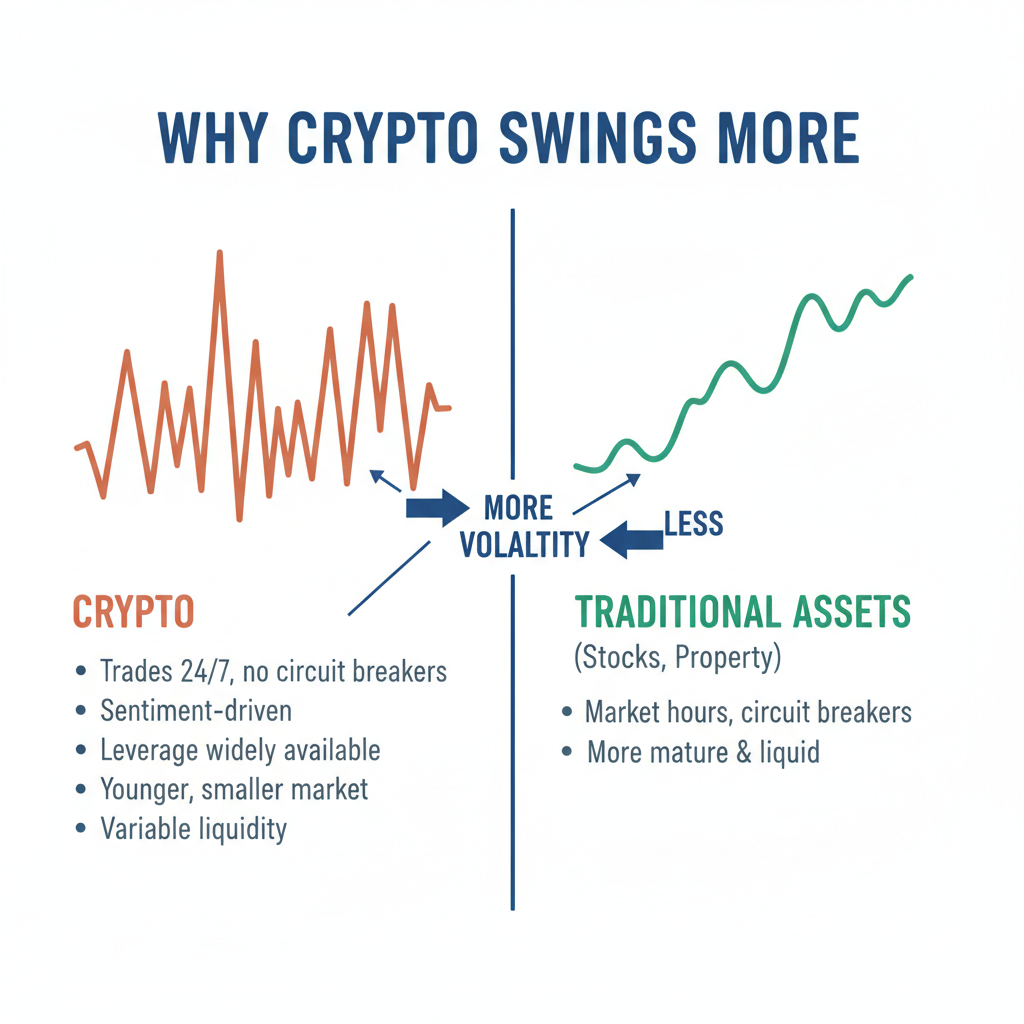
Several features combine to make crypto swing more than traditional assets:
- It's a younger, smaller market, so it moves more on a given amount of buying or selling.
- It trades 24/7 with no circuit breakers, so moves can run unchecked at any hour.
- It's heavily sentiment-driven, with many assets lacking the earnings or cash flows that anchor traditional valuations.
- Leverage is widely available, fuelling liquidation cascades.
- Liquidity varies, and thinner markets move more violently.
This is exactly why position sizing and only investing what you can afford to lose matter so much in crypto. (Our guide comparing crypto, stocks and property explores the differences.)
What to do when crypto is crashing
The causes are interesting, but what matters is your response. The key is not to let fear drive decisions:
- Don't panic-sell. Selling in a crash locks in losses and is how many people turn a paper dip into a real loss. Fear is the enemy of good decisions.
- Zoom out. Look at longer timeframes and remember crashes are recurring. The minute-to-minute panic looks different against the bigger picture.
- Revisit your plan, not your emotions. If you decided your goals, horizon, and budget in calm (as our beginner's roadmap suggests), a crash is a test of that plan, not a reason to abandon it.
- Only ever have invested what you can afford to lose. If a crash is causing you genuine distress, that may be a sign your position was too large for your situation, a lesson for sizing, not a reason to panic now.
- Avoid leverage, which turns volatility into forced losses.
- Consider that volatility cuts both ways, but never invest on the assumption of a rebound; there are no guarantees.
Common mistake: panic-selling at the bottom of a crash, then watching from the sidelines. The investors who fare worst are usually those who let fear, not their plan, make the call.
What not to do: make impulsive decisions, check prices obsessively, chase the fall down with leverage, or assume either that it will definitely recover or that it's definitely "over." (Our guides on whether to buy, hold or sell and on taking profit can help you think clearly rather than react.)
Common mistakes when crypto crashes
- Panic-selling and locking in losses out of fear.
- Obsessively checking prices and amplifying your own stress.
- Using leverage, turning a dip into forced liquidation.
- Assuming a guaranteed rebound, or assuming permanent decline.
- Abandoning a sound plan because of short-term emotion.
- Having invested more than you could afford to lose in the first place.
- Reacting to FUD and rumours without perspective.
Frequently asked questions
Why does crypto crash so often?
Sharp drops are a normal feature of crypto because of how the market is built. It's heavily driven by sentiment, moving in cycles of euphoria and fear; widely available leverage means falling prices trigger forced liquidations that cascade into bigger crashes; it responds to macro conditions like interest rates and risk appetite; and it's a younger, 24/7 market that moves more on a given amount of buying or selling. Add regulatory news, occasional collapses or hacks, and profit-taking, and frequent volatility is the result. Crashes aren't a sign the market is broken, they're a defining characteristic of the asset class.
Should I sell my crypto when it's crashing?
Selling purely because the price is falling is usually a fear-driven reaction rather than a sound decision, and it locks in losses, many people who panic-sell in a crash end up worse off than those who stuck to a plan. That said, whether to sell depends on your individual goals, your view of the asset, and your circumstances, not on the panic of the moment. The key is to make the decision based on a plan you set in calm, not on emotion during a crash. If a crash is causing you serious distress, that may signal your position was too large. Our guide on buy/hold/sell decisions can help.
Is a crypto crash a good time to buy?
Some investors view downturns as opportunities, and "buying the dip" is a common idea, but it's risky and not guaranteed, because a falling price can keep falling, and there's no way to know where the bottom is. Never invest on the assumption that prices will rebound. If you do invest during downturns, dollar-cost averaging (investing a fixed amount on a schedule) is a more measured approach than trying to time the exact bottom. And only ever invest money you can afford to lose. A crash is not automatically a buying opportunity, treat confident "now's the time" claims with scepticism.
What causes the really fast, sharp crypto crashes?
The fastest, most violent drops are often driven by leverage liquidations rather than news. Many traders use borrowed money to amplify their positions; when prices fall, those positions get automatically closed (liquidated), forcing selling that pushes prices lower, which triggers still more liquidations, a self-reinforcing cascade that can unfold in hours. This is why crypto can drop dramatically and quickly, sometimes without an obvious headline cause. It's also why avoiding leverage yourself is wise: it's the mechanism that turns ordinary volatility into forced, rapid losses for those caught in it.
Why is crypto more volatile than the stock market?
Several factors combine. Crypto is a younger and smaller market, so it moves more on a given amount of trading. It runs 24/7 with no circuit breakers, so moves can run unchecked at any hour. It's heavily sentiment-driven, and many crypto assets lack the earnings or cash flows that anchor traditional valuations. Leverage is widely available, fuelling liquidation cascades. And liquidity varies, with thinner markets moving more violently. Together these make crypto's swings far larger than those of established assets like stocks or property, which is why sizing your position carefully and only investing what you can afford to lose matter so much.
Will crypto always recover after a crash?
There's no guarantee. While the overall crypto market has recovered from major crashes in the past, past performance doesn't guarantee future results, and individual assets can and do fail to recover, some go to zero. Treating recovery as certain is dangerous, and you should never invest on that assumption or with money you can't afford to lose. The market's history of volatility cuts both ways: large gains and large, sometimes permanent, losses are both possible. Make decisions based on your own research and risk tolerance, not on a belief that "it always comes back," because for specific assets, it doesn't always.
How do I stop myself from panic-selling?
The best defences are set in advance. Decide your goals, time horizon, and budget while calm, and write down a simple plan, so when a crash hits, you're testing that plan rather than reacting to fear. Only invest what you can afford to lose, so a drop doesn't threaten your essential finances or your peace of mind. Avoid checking prices obsessively, which amplifies stress, and zoom out to longer timeframes for perspective. Remember that crashes are a recurring feature, not a unique disaster. If volatility is causing serious distress, that's a signal to reduce your position size in future, not to make impulsive decisions now.
Does macroeconomic news really affect crypto?
Yes, increasingly so. Crypto has come to move with broader risk assets, responding to forces like interest rates, inflation, liquidity, and overall investor risk appetite. When central banks tighten policy or economic uncertainty rises, money often flows out of riskier assets, including crypto, toward safer ones, which can drive crypto down even when nothing crypto-specific has changed. So a crypto fall sometimes reflects global economic conditions rather than anything about crypto itself. This connection to the wider economy is one reason crypto doesn't move in isolation and why macro developments are a recurring source of volatility.
How long do crypto bear markets usually last?
There's no fixed answer, historically, crypto downturns have ranged from sharp, short drops to extended bear markets lasting many months or longer, and past patterns don't guarantee future ones. Trying to predict the exact length or bottom of a downturn is unreliable, and acting on confident predictions is risky. Rather than guessing the timing, a sounder approach is to have a plan, only invest what you can afford to lose, avoid leverage, and not let a downturn force panic decisions. Focus on what you can control, your sizing, your plan, and your reactions, rather than forecasting how long a fall will last.
Worried about volatility and want a calm, independent view on whether your crypto holdings suit your risk tolerance? Get a portfolio review with no token holdings, no conflicts, and no hype, built for Australian investors who want clarity, not noise. Book a free review call.
Explore all how-to guides

Mario Stanic · Founder, Crypto Research Australia
Founder of Crypto Research Australia and a self-taught algorithmic trading expert with a proven track record executing multi-billion-dollar trading volume across futures and spot markets. Featured as a crypto expert and market analyst in the Sydney Morning Herald, The Age, the Australian Financial Review, and Channel 9.
Thanks for reading. Take it from the top, or keep exploring our research.