How to Do Your Crypto Tax in Australia (Step-by-Step)
A step-by-step guide to doing your crypto tax in Australia - gathering transactions, identifying taxable events, using crypto tax software, calculating capital gains with the 50% discount, reporting via myTax or a tax agent, and the 2027 CGT changes.
The short answer
Doing your crypto tax in Australia is mostly about good records and knowing which transactions are taxable. Here's the whole process:
- Gather every transaction across all your exchanges and wallets, buys, sells, swaps, and rewards.
- Identify the taxable events, selling, swapping, and spending crypto trigger capital gains tax; staking rewards and airdrops are usually income.
- Use crypto tax software to import your data and do the heavy lifting (or work with a registered tax agent).
- Calculate your capital gains and losses, applying the 50% discount where you held over 12 months, and offsetting losses.
- Report it in your tax return, via myTax or your tax agent, and keep records for at least five years.
The ATO knows more about crypto than most people realise (it runs a data-matching program), so the goal is to get it right, not to hope it's invisible. The good news: with software and a clear process, it's very manageable. Here's how.
Note: This is general educational information, not personal tax advice. Crypto tax depends on your circumstances and the rules are changing (see the 2027 note below). For advice specific to you, use a registered tax agent, verify them on the Tax Practitioners Board register.
What you'll need
- A list of every exchange and wallet you've used.
- Your complete transaction history from each (most exchanges let you export a CSV or connect via API).
- Records of what you paid (cost base), including fees, and when.
- Records of any staking rewards, airdrops, or crypto income and their AUD value when received.
- (Recommended) crypto tax software to bring it all together.
First: what's taxable and what isn't
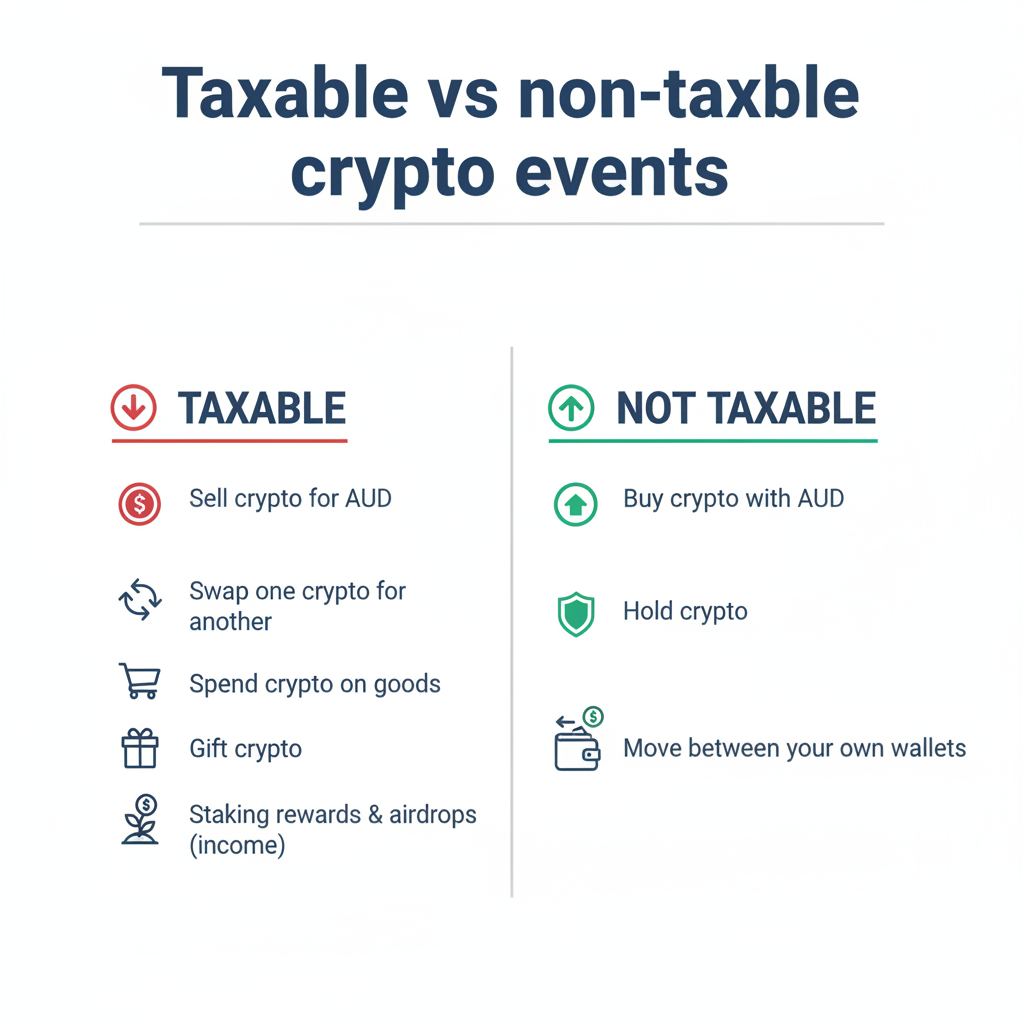
Understanding which events trigger tax is half the battle. In Australia, crypto is generally treated as a CGT asset, and some events are income. Broadly:
| Event | Tax treatment |
|---|---|
| Buying crypto with AUD | Not taxable (but record the cost base) |
| Holding crypto | Not taxable |
| Transferring between your own wallets | Not taxable (keep records) |
| Selling crypto for AUD | CGT event |
| Swapping one crypto for another | CGT event (commonly missed) |
| Spending crypto on goods/services | CGT event |
| Gifting crypto | CGT event |
| Staking rewards / airdrops | Ordinary income at AUD value on receipt |
The two big surprises for people are that swapping one crypto for another is a taxable disposal (even with no AUD involved), and that staking rewards are income when received (then CGT applies when you later sell them).
The process, step by step
Step 1: Gather every transaction
Pull together your complete history from every platform you've used, exchanges and wallets. Most exchanges offer a CSV export or an API connection. Don't forget smaller or older accounts, on-chain wallet activity, and any DeFi or staking. Missing transactions are the most common cause of incorrect crypto tax, so be thorough. This step is the foundation; everything else builds on it.
Step 2: Identify the taxable events
Go through your transactions and categorise them using the table above. Separate your CGT events (sells, swaps, spends, gifts) from your income events (staking rewards, airdrops). For income events, you'll need the AUD value at the time of receipt. Good crypto tax software does much of this categorisation automatically, but understanding it helps you check the results.
Step 3: Use crypto tax software
For anyone with more than a handful of transactions, crypto tax software is worth it. You connect your exchanges and wallets (via API or CSV), and the software aggregates everything, categorises events, fetches historical AUD values, and calculates your gains, losses, and income. It handles the tedious parts, matching disposals to cost bases, applying the 50% discount, and producing a report you (or your agent) can use.
Common mistake: trying to calculate everything by hand across multiple exchanges and wallets. It's error-prone and exhausting. Software (or a crypto-experienced tax agent) saves hours and reduces mistakes. (See our guide comparing crypto tax software, an accountant, and DIY.)
Step 4: Calculate your gains and losses
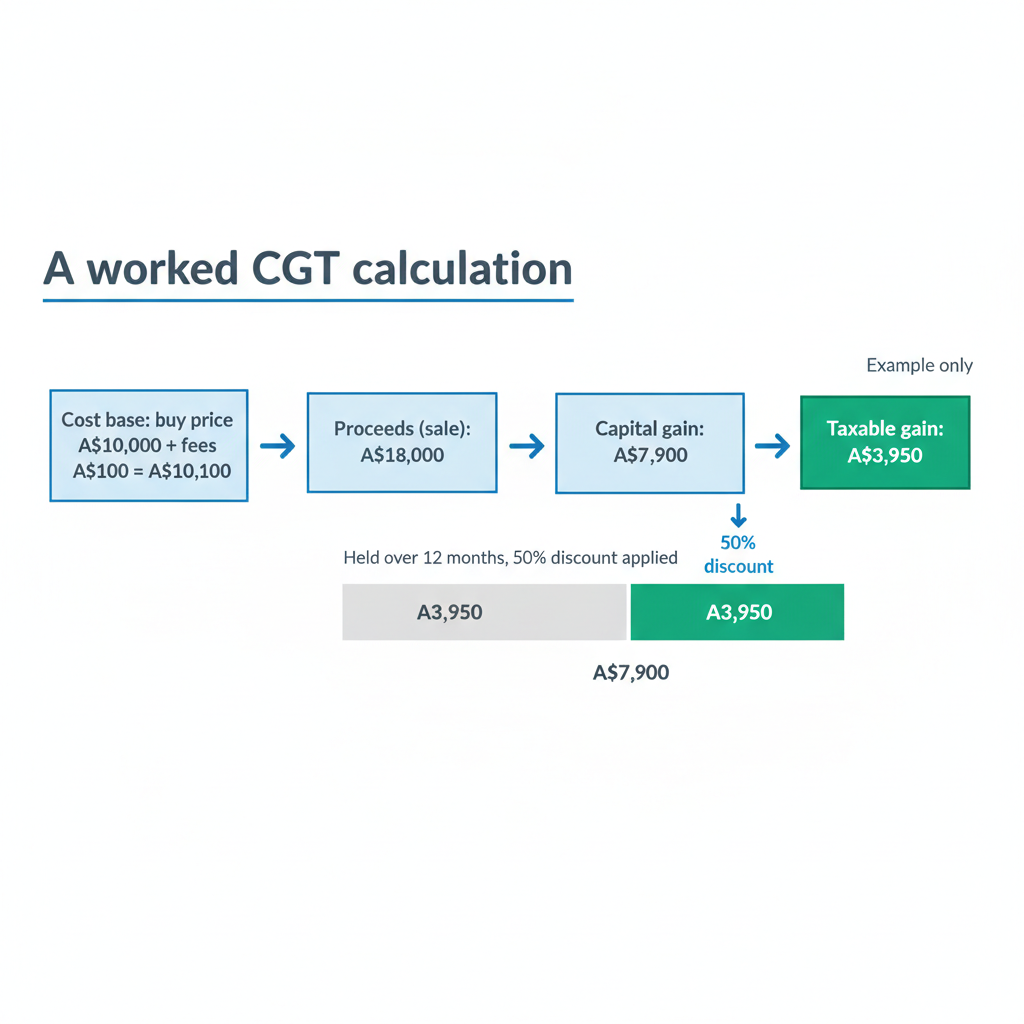
For each CGT event, the gain or loss is the proceeds minus the cost base (what you paid plus fees). Then:
- Apply the 50% CGT discount to gains on assets held more than 12 months (for individuals), currently.
- Offset capital losses against capital gains; carry unused losses forward to future years.
- Add staking/airdrop income (at AUD value on receipt) to your assessable income.
Step 5: Report it in your tax return
Include your net capital gain and any crypto income in your tax return, via myTax (the ATO often pre-fills some crypto data from its data-matching) or through your registered tax agent. Review any pre-filled figures against your own records, pre-fill is a prompt, not necessarily complete or final.
Step 6: Keep your records
Keep records of everything for at least five years, transaction histories, AUD values, cost bases, and your calculations. The ATO can review returns, and crypto records need to hold up. Storing your software reports and exports each year makes future tax time (and any review) far easier.
A few things worth knowing
- The ATO's data-matching program collects data from Australian exchanges and matches it to taxpayers, so assume your activity is visible. Reporting correctly is the only sound approach.
- Investor vs trader: most people are investors (gains taxed under CGT, eligible for the discount). Those operating as a trading business are taxed differently (as business income, no CGT discount). Which applies depends on your activity, a tax agent can advise.
- Deductions: fees for crypto tax software and a registered tax agent are generally deductible, and certain costs can form part of your cost base.
- DeFi and complex activity (liquidity pools, lending, wrapping) can have intricate tax treatment, software helps, but complex situations are worth a tax agent's review.
- Made a mistake in a past return? The ATO generally views voluntary disclosure favourably compared to being caught, amending is better than ignoring.
The upcoming change: as announced in the May 2026 Federal Budget, from 1 July 2027 the 50% CGT discount is to be replaced (for individuals) with a system based on inflation indexation plus a 30% minimum tax on net gains, applying broadly across crypto, shares, and property. Gains made before 1 July 2027 keep the current 50% discount. This is subject to final legislation, so confirm the current rules with a registered tax agent. (Our crypto tax guide covers the detail.)
Airdrops, forks and other tricky cases
A few situations need extra care. Airdrops (free tokens distributed to wallets) are generally treated as ordinary income at their AUD value when you receive them, then subject to CGT when you later dispose of them, the same two-step treatment as staking rewards. Chain splits (forks), where a blockchain divides and you receive new coins, have their own ATO treatment worth checking. DeFi activity, providing liquidity, lending, wrapping tokens, can trigger CGT events in ways that aren't always obvious, since moving in and out of protocols may count as disposals. Lost or stolen crypto may be claimable as a capital loss in some circumstances, with evidence. These edge cases are exactly where crypto tax software plus a registered tax agent earn their keep, don't guess on the tricky ones.
Common mistakes doing crypto tax
- Not realising swaps are taxable, crypto-to-crypto swaps are CGT events.
- Forgetting staking/airdrop income at receipt, then the CGT on disposal.
- Missing transactions from old accounts, wallets, or DeFi activity.
- Trying to do it all by hand instead of using software or an agent.
- Not keeping records of cost bases and dates.
- Assuming the ATO can't see it, the data-matching program says otherwise.
- Ignoring capital losses that could offset gains.
- Relying solely on pre-fill without checking it against your own records.
Frequently asked questions
Do I have to pay tax on crypto in Australia?
Yes, in the relevant situations. Crypto is generally treated as a CGT asset, so disposing of it, selling for AUD, swapping one crypto for another, spending it, or gifting it, is a capital gains tax event, and any gain is taxable (with a 50% discount currently available for assets held over 12 months by individuals). Separately, staking rewards and airdrops are usually treated as income when received. Simply buying and holding isn't taxable, but you must keep records. The ATO runs a data-matching program, so reporting correctly is essential.
How do I actually calculate my crypto capital gains?
For each disposal, your capital gain or loss is the proceeds (what you received) minus your cost base (what you originally paid, plus fees). If you held the asset for more than 12 months, you generally apply the 50% CGT discount to the gain (currently). You then offset any capital losses against gains, carrying unused losses forward. Doing this across many transactions by hand is difficult, which is why crypto tax software, which matches disposals to cost bases and applies the discount automatically, is so useful. A registered tax agent can also handle it.
Is crypto tax software worth using?
For anyone with more than a few transactions, generally yes. It connects to your exchanges and wallets, aggregates all your activity, categorises taxable events, fetches historical AUD values, applies the 50% discount, and produces a report, saving hours and reducing errors compared to doing it by hand. The fees are usually modest and often tax-deductible. For very simple situations (a couple of transactions), you might manage manually, but as soon as you've used multiple platforms or done swaps and staking, software earns its keep. Our guide comparing software, an accountant, and DIY covers the options.
Does the ATO really know about my crypto?
Assume so. The ATO operates a crypto data-matching program that collects information from Australian exchanges and matches it to taxpayers, and it often pre-fills some crypto data in myTax. This means undisclosed crypto activity is far more visible than many people assume. The sound approach is always to report correctly and keep good records, rather than hoping it goes unnoticed. If you've made mistakes in the past, voluntary disclosure is generally viewed more favourably than being caught, amending a return is better than ignoring the issue.
Do I pay tax if I only swapped crypto and never cashed out to dollars?
Yes, this surprises many people. Swapping one cryptocurrency for another is treated as disposing of the first asset, which is a capital gains tax event, even though you never converted to Australian dollars. You calculate the gain or loss in AUD based on the value at the time of the swap. So even if you've never withdrawn a dollar to your bank, your swaps may have created taxable events. This is one of the most commonly missed points, so make sure every swap is in your records, and confirm your position with a registered tax agent.
How long do I need to keep my crypto tax records?
Generally at least five years from when you lodge the relevant return, since the ATO can review returns within that window (and longer in cases of fraud or evasion). Keep your full transaction histories, the AUD values used, your cost-base calculations, and the reports your software produces. Storing these each year makes future tax time easier and means you're prepared if the ATO ever asks questions. Good record-keeping is the single best thing you can do to make crypto tax straightforward and to protect yourself in a review.
Can I reduce my crypto tax legally?
There are legitimate ways to manage your position, not to evade tax, but to plan sensibly. Examples include being mindful of the 12-month holding mark for the CGT discount (under current rules), offsetting capital gains with capital losses, carrying forward unused losses, and claiming deductible costs like tax software and agent fees. Timing disposals across financial years can also matter. These are planning considerations, not avoidance. A registered tax agent can help you apply them to your situation. Always keep complete records, and be aware the rules are changing from 1 July 2027.
Should I use an accountant or do my crypto tax myself?
It depends on the complexity of your activity. For simple situations, crypto tax software may be enough to prepare everything yourself. For more complex activity, many transactions, multiple platforms, DeFi, staking, or uncertainty about investor-versus-trader status, a registered tax agent experienced with crypto is worth it, and their fee is generally deductible. Many people use both: software to organise the data, and an agent to review and lodge. Our guides on whether you need a crypto accountant and on software versus an accountant versus DIY can help you decide.
Are airdrops taxable in Australia?
Generally yes. Airdropped tokens are usually treated as ordinary income at their AUD value when you receive them, and then a separate capital gains tax event applies when you later sell or swap them (with the cost base being their value at receipt). This is the same two-step treatment as staking rewards. So even tokens you received for "free" can create a tax obligation. Keep a record of what you received, when, and its AUD value at the time. As always, the treatment can depend on the specifics, so confirm with a registered tax agent.
What if I've used many exchanges and can't find all my records?
Start by retrieving what you can, most exchanges let you re-download transaction history (CSV) or reconnect via API even for past years, and blockchain explorers can show on-chain wallet activity. Crypto tax software is designed to pull from many sources and reconcile them. If records are genuinely missing, the ATO expects a reasonable, good-faith effort to reconstruct them, and a registered tax agent can advise on how to handle gaps. Going forward, keep everything in one place each year. The effort to gather complete records now is far less painful than a problem in a future ATO review.
Want an independent, expert second opinion on your crypto holdings before tax time, including how your records and position stack up? No token holdings, no conflicts, just clarity. Book a free portfolio review call. (For lodging your return, use a registered tax agent.)
Next in the how-to hub
Next in the how-to hub: build your market literacy with how to read a crypto chart and understand the metrics that actually matter.
Explore all how-to guides

Mario Stanic · Founder, Crypto Research Australia
Founder of Crypto Research Australia and a self-taught algorithmic trading expert with a proven track record executing multi-billion-dollar trading volume across futures and spot markets. Featured as a crypto expert and market analyst in the Sydney Morning Herald, The Age, the Australian Financial Review, and Channel 9.
Thanks for reading. Take it from the top, or keep exploring our research.