How to Start Investing in Crypto the Right Way: A Beginner's Roadmap
A beginner's roadmap to starting in crypto the right way in Australia - learn first, size your budget, set up securely, buy small with DCA, self-custody and keep records, build a plan, and review calmly. The sensible order that avoids the classic mistakes.
The short answer
Starting in crypto the right way isn't about picking the "best coin", it's about following a sensible order so you don't make the mistakes that catch most beginners. Here's the roadmap:
- Learn the basics first, don't invest in what you don't understand.
- Decide how much to invest, only money you can afford to lose, sized to your situation.
- Set up securely, a regulated exchange, your own wallet, and good security from day one.
- Make your first purchase, start small, and consider buying gradually rather than all at once.
- Secure it and keep records, self-custody meaningful holdings; track everything for tax.
- Build a plan and avoid the classic mistakes, chasing hype, panic-selling, and over-investing.
- Review periodically, calmly, on a schedule, not in reaction to every price move.
Get the order right and crypto becomes far less daunting. This roadmap pulls together everything in our how-to hub into one path, and points you to the deeper guides at each step. Here's your first 30 days and beyond.
Note: This is general educational information, not personal financial advice or a recommendation to invest in crypto. Crypto is high-risk and volatile, and you can lose money. For advice specific to your situation, see an ASIC-licensed financial adviser; for tax, a registered tax agent.
What you'll need
- An open mind and a little time to learn before you invest.
- A clear sense of your finances, what you can genuinely afford to put at risk.
- An Australian bank account and photo ID for getting set up.
- Patience, the goal is a sound foundation, not rushing in.
The roadmap at a glance
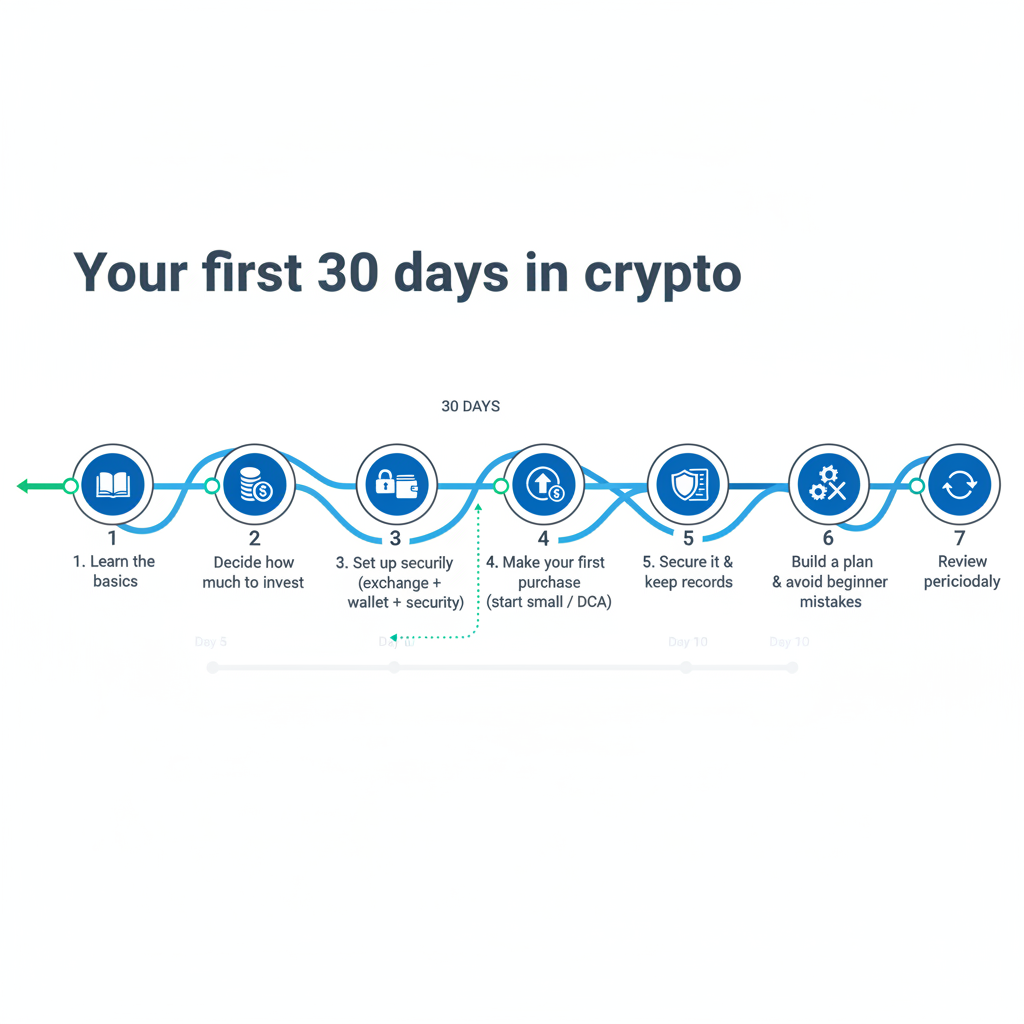
The seven steps, in order:
- Learn the basics.
- Decide how much to invest.
- Set up securely (exchange + wallet + security).
- Make your first purchase (start small / DCA).
- Secure it and keep records.
- Build a plan and avoid beginner mistakes.
- Review periodically (calmly, on a schedule).
Step 1: Learn the basics first
The single best thing a beginner can do is understand what they're buying before buying it. You don't need to become an expert, but you should grasp the fundamentals: what crypto and blockchain are, how wallets and keys work, the difference between major assets, and the real risks. Investing in something you don't understand, because a friend, an influencer, or hype told you to, is how beginners lose money.
Spend a little time with the earlier guides in this hub and our research material. The few hours you invest in learning will save you far more than they cost. Never invest in a crypto purely because someone told you to or because it's "going up."
Step 2: Decide how much to invest
Before you buy anything, decide your budget, and stick to it. Two rules:
- Only invest money you can afford to lose. Crypto is volatile; never use money you need for rent, bills, emergencies, or essential goals.
- Size it to your situation. Crypto is a high-risk slice of a portfolio, not the whole thing. Many people keep it to a modest percentage of their overall investments. The right figure depends on you, our guide on how much of your money should be in crypto helps you think it through.
Deciding this first protects you from the most common beginner trap: getting excited and putting in far more than is sensible. A budget set in calm beats a number chosen in a frenzy.
Common mistake: investing money you can't afford to lose, or pouring in far more than planned because prices are rising. Set your limit before you start, and respect it.
Step 3: Set up securely
With a budget set, get your infrastructure right before you have much at stake:
- Choose an AUSTRAC-registered Australian exchange, verify it on AUSTRAC's register (see our guide on choosing an exchange).
- Create and verify your account (KYC) and enable app-based two-factor authentication immediately.
- Set up your own wallet for holding meaningful amounts, ideally a hardware wallet for the long term (see our wallet setup guide).
- Work through the security basics, protect your seed phrase, use unique passwords, and learn to spot scams (our security checklist covers it).
Doing security first means you're protected from your very first purchase, rather than scrambling to lock things down later. This step prevents the most damaging beginner losses, which come not from bad investments but from hacks, scams, and lost keys.
Step 4: Make your first purchase (start small)
Now you buy, calmly and modestly:
- Deposit Australian dollars (PayID is usually free and fast).
- Start small. Your first purchase is partly about learning the process; there's no need to deploy your whole budget at once.
- Consider dollar-cost averaging (DCA) rather than a single lump sum. DCA means investing a fixed amount on a regular schedule, smoothing out the price you pay and removing the pressure to "time" the market.
| Approach | How it works | Suits |
|---|---|---|
| Dollar-cost averaging | Fixed amount, regular schedule | Most beginners; reduces timing stress |
| Lump sum | Invest it all at once | Those comfortable with timing risk |
For most beginners, DCA is the calmer path, it takes the emotion and guesswork out of when to buy, and many Australian exchanges let you automate recurring buys. (Our guide on buying crypto walks through the mechanics.)
Common mistake: going "all in" at once, often near a price peak driven by hype. Starting small and spreading purchases reduces both risk and regret.
Step 5: Secure it and keep records
Once you own crypto:
- Move meaningful holdings into your own wallet (self-custody), rather than leaving everything on the exchange. Use the exchange to transact, not as a vault.
- Keep records from day one, every buy, sell, and swap matters for Australian tax (selling and swapping are CGT events). Start a simple record or connect crypto tax software now (see our crypto tax guide), so tax time isn't a scramble.
This habit, built early, saves enormous hassle later, both for security and for tax.
Step 6: Build a plan and avoid the classic mistakes
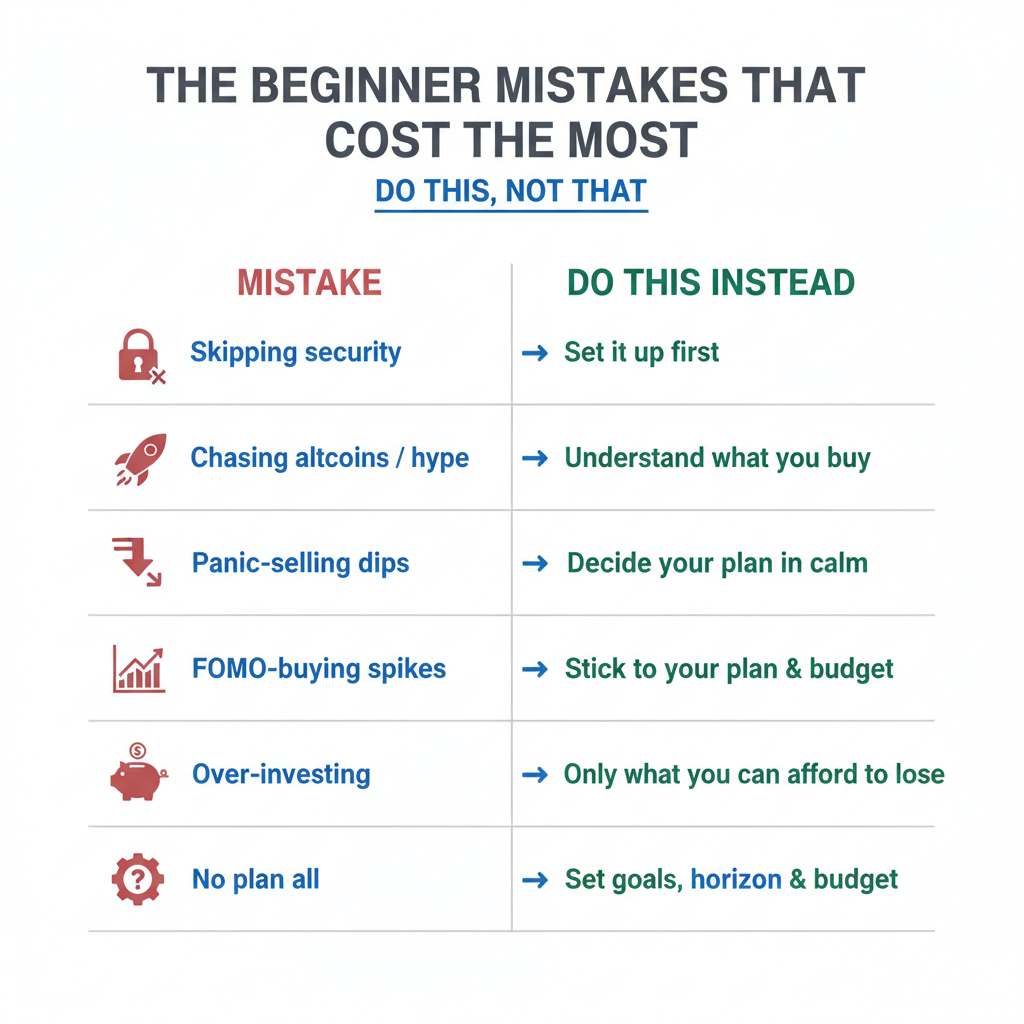
Most beginner losses come from a predictable handful of mistakes. Knowing them is half the battle:
| Beginner mistake | What to do instead |
|---|---|
| Skipping security | Set it up first (Step 3), it's the costliest thing to neglect |
| Chasing altcoins / hype | Understand what you buy; be wary of "next 100x" promises |
| Panic-selling in dips | Expect volatility; decide your plan in calm, not in fear |
| FOMO-buying in spikes | Don't chase green candles; stick to your plan and budget |
| Over-investing | Only what you can afford to lose; size it sensibly |
| No plan at all | Decide your goals, horizon, and approach up front |
A simple plan answers: Why am I investing (goal)? For how long (horizon)? How much (budget)? What will I do if it falls 50% (it can)? Writing this down, even a few lines, keeps you steady when emotions run high. The biggest enemy of a beginner's returns isn't the market; it's their own reactions to it. (Our guides on taking profit and on whether to buy, hold or sell go deeper.)
Step 7: Review periodically
Finally, review calmly and on a schedule, not in reaction to every headline or price swing. Periodically check that your holdings still fit your plan, your security is sound, and your records are up to date. Crypto's 24/7 markets and constant noise tempt people into over-monitoring and over-trading; resist it. A considered review every so often beats anxious daily checking. Watching for signs your portfolio needs attention (our guide on portfolio health checks covers these) is far more useful than reacting to every move.
Common mistakes when starting out
- Investing before understanding what you're buying.
- Skipping security setup until after you've bought.
- Over-investing or using money you can't afford to lose.
- Going all-in at once, often near a hype-driven peak.
- Chasing altcoins and "100x" promises instead of learning fundamentals.
- Panic-selling dips and FOMO-buying spikes.
- Not keeping records for tax from the start.
- Having no plan, so emotions drive decisions.
Frequently asked questions
How do I start investing in crypto as a complete beginner?
Follow a sensible order rather than rushing to pick a coin. First, learn the basics so you understand what you're buying. Second, decide how much to invest, only money you can afford to lose. Third, set up securely: a regulated AUSTRAC-registered exchange, your own wallet, and good security habits. Fourth, make a small first purchase, ideally spreading buys over time (dollar-cost averaging). Fifth, secure your holdings and keep records for tax. Sixth, build a simple plan and learn the common beginner mistakes. Finally, review calmly and periodically. Getting the order right matters more than picking the "perfect" first coin.
How much should I invest in crypto when starting?
Only money you can afford to lose, and sized as a modest part of your overall finances rather than the bulk of them, crypto is a high-risk asset. The exact figure depends on your circumstances, goals, and risk tolerance, so there's no universal number. Many people keep crypto to a small percentage of their total investments. Crucially, decide this budget in advance and stick to it, rather than getting carried away as prices rise. Starting small while you learn is sensible. Our guide on how much of your money should be in crypto helps you think it through properly.
Should I invest all at once or a bit at a time?
For most beginners, investing gradually, dollar-cost averaging, is the calmer approach. It means putting in a fixed amount on a regular schedule, which smooths out the price you pay and removes the pressure and guesswork of trying to "time" the market. This reduces both risk and the regret of investing a lump sum just before a fall. Lump-sum investing can work for those comfortable with timing risk, but DCA suits beginners better because it takes emotion out of the decision. Many Australian exchanges let you automate recurring buys to make this easy.
What's the most important thing to get right as a beginner?
Security and not over-investing. The most damaging beginner losses usually come not from bad investment choices but from hacks, scams, lost keys, and putting in more than they could afford to lose. So setting up good security from the start, protecting your seed phrase, using app-based 2FA, learning to spot scams, and sticking to a sensible budget will protect you more than any coin pick. Beyond that, learning the basics before investing and having a simple plan to avoid emotional decisions round out the foundation. Get these right and you've avoided most beginner disasters.
Which cryptocurrency should I buy first?
We don't tell people what to buy, that depends on your situation, and anyone promising the "next big coin" should be treated with scepticism. More useful than a specific pick is learning how to decide: understanding an asset's fundamentals, its risks, and how it fits your goals, rather than chasing hype or what's currently rising. Many beginners start by understanding the largest, most established assets before considering smaller, riskier ones. Our guides on what crypto to buy (how to decide) and how to judge a crypto investment focus on building that judgement, which serves you far better than a tip.
What are the biggest mistakes beginners make?
The classics are: skipping security setup (the costliest), chasing altcoins and hype-driven "100x" promises, panic-selling during dips, FOMO-buying during spikes, over-investing or using money they can't afford to lose, and having no plan so emotions drive their decisions. Almost all of these are avoidable by following a sensible order: learn first, size sensibly, secure properly, start small, keep records, and decide a plan in calm rather than reacting to the market. The biggest threat to a beginner's returns is usually their own reactions, not the market itself.
How often should I check my crypto?
Less often than you'll be tempted to. Crypto markets run 24/7 and generate constant noise, which tempts beginners into over-monitoring and over-trading, both of which tend to hurt returns and raise stress. A calm, periodic review (checking that your holdings still fit your plan, your security is sound, and your records are current) is far more useful than anxious daily price-watching. Set a schedule that suits your horizon, if you're investing for years, checking obsessively every day serves no purpose. Reacting to every swing is the enemy of sound long-term investing.
Do I need a financial adviser to start investing in crypto?
Not necessarily, but it can help depending on your situation. This roadmap and our guides give you the general knowledge to start sensibly on your own. However, for personal financial advice, how crypto fits your overall finances, goals, and risk tolerance, an ASIC-licensed financial adviser can provide guidance specific to you, which general educational content can't. For tax, a registered tax agent is the right professional. And for an independent, expert second opinion on your crypto holdings specifically, that's exactly what our portfolio review offers. Use professionals where your situation is complex or the stakes are high.
Can I lose all my money in crypto?
Yes, crypto is high-risk, and it's possible to lose your entire investment, whether through a crash, a failed project, a scam, or lost access to your funds. Individual assets can go to zero, and even established ones are highly volatile. This is exactly why the core rules matter so much: only invest money you can afford to lose, size crypto as a modest part of your finances, secure your holdings properly, and never invest in something you don't understand or because of hype. Treating crypto as money you could lose entirely keeps your decisions, and your stress levels, sensible.
Just starting out and want an independent expert to check you're set up the right way, before you go further? Get a portfolio review with no token holdings, no conflicts, and no hype, just clear, honest guidance built for Australian investors. Book your free review call.
Next in the how-to hub
Next in the how-to hub: ready to go further? Learn how to use DeFi safely, and the real risks involved before you explore it.
Explore all how-to guides

Mario Stanic · Founder, Crypto Research Australia
Founder of Crypto Research Australia and a self-taught algorithmic trading expert with a proven track record executing multi-billion-dollar trading volume across futures and spot markets. Featured as a crypto expert and market analyst in the Sydney Morning Herald, The Age, the Australian Financial Review, and Channel 9.
Thanks for reading. Take it from the top, or keep exploring our research.